
Reviewed · CITY TOURS
Budapest City Landmarks Walking Tour in 2 Hours
Budapest reveals itself quickly on this walk: grand churches, café-lined squares, the Danube, the Chain Bridge, Shoes on the Danube Bank, and Parliament all fit into one useful introduction. You begin near the Budapest Eye and finish by the river, with enough context to decide where to spend the rest of your visit.
I like the low upfront price and the practical advice woven into the history. You get restaurant tips, Hungarian food pointers, a few local words, and suggestions for nightlife and later sightseeing. I also like the route’s range, from Herendi porcelain and Art Nouveau design to the Holocaust memorial and the views toward Buda Castle.
The main consideration is pace. This is a broad Pest-side survey, not a slow architectural study, and the group can reach 30 people. The Basilica is viewed from outside, and the guide works mainly for tips, so the $3.63 booking price is not the full cost of the experience.
In This Review
- Key points to know before you book
- Why this Pest walking tour works well on your first day
- Starting at Erzsébet Square and the Budapest Eye
- St. Stephen’s Basilica and the food talk in its square
- Habsburg connections and Budapest’s decorative arts
- Vörösmarty Square, Váci utca, and the old café tradition
- The Danube Embankment brings the best views
- The Little Princess and Vigadó Square
- The Chain Bridge explains Buda and Pest
- Gresham Palace shows Budapest’s Art Nouveau side
- Hungarian inventions, famous names, and a few useful words
- Shoes on the Danube Bank asks for quiet attention
- Parliament is a fitting final stop
- What the price really means
- Timing, group size, and the walking effort
- Who should book this Budapest walk
- Should you book it?
- FAQ
- How long does the Budapest City Landmarks Walking Tour last?
- Where does the walking tour start?
- Where does the tour finish?
- Is the tour offered in English?
- Does the tour enter St. Stephen’s Basilica?
- How much does the tour cost?
- How large can the group be?
- What happens if the weather is poor?
Key points to know before you book

- A strong first-day orientation: The route covers central Pest and ends at Parliament, giving you a useful map of the city.
- Local advice beyond sightseeing: Expect food guidance, restaurant suggestions, nightlife ideas, and basic Hungarian phrases.
- A Danube-centered finish: The riverfront brings views of Buda Castle, Matthias Church, Fisherman’s Bastion, and Gellért Hill.
- History with personal color: Guides such as Gary, Dora, Rita, Esther, Judith, and Andy are praised for clear stories, humor, and approachable answers.
- Bring water and arrive early: The walk is outdoors, requires steady walking, and finding the blue-flag guide matters at the start.
Why this Pest walking tour works well on your first day
Budapest is easier to understand once you know the basic split between Buda and Pest. This walk stays mostly on the Pest side, but from the Danube you look across at Buda’s hills, castle, churches, and old fortifications.
That makes the route useful even if you have only just arrived. You see where the main squares are, how the riverfront connects to central Pest, and which buildings deserve a return visit. I would schedule it early in your stay, then use the guide’s final recommendations to shape the next day or two.
The tour combines history, architecture, public art, food, society, language, and everyday Hungarian life. That mix keeps the experience from becoming a string of dates and building names. You might hear about a famous architect in one minute, then learn what to order for lunch or how to avoid a tourist trap in the next.
The 4.9 out of 5 rating from 2,048 ratings reflects a strong pattern: the guides are often praised for being friendly, clear, funny, and easy to hear. Gary is singled out for packing the two hours with stories and useful advice. Dora is praised for making Hungarian history easy to follow while handling a larger group calmly. Rita receives praise for her energy and strong voice, while Esther is noted for being engaging and clear.
Guide quality always depends on the person assigned that day, but the repeated theme is reassuring. This is not meant to be a formal lecture. It is a moving conversation with plenty of chances to ask questions.
More walking tours in Budapest:
- Budapest: Buda Castle Walk with Saint Stephen’s Hall
★ 4.5 · 3,012 reviews - Big Bus Budapest Hop-On Hop-Off Bus and Walking Tour
★ 3.5 · 2,206 reviews - Budapest: Buda Castle District Walking Tour
★ 4.6 · 2,108 reviews
Starting at Erzsébet Square and the Budapest Eye
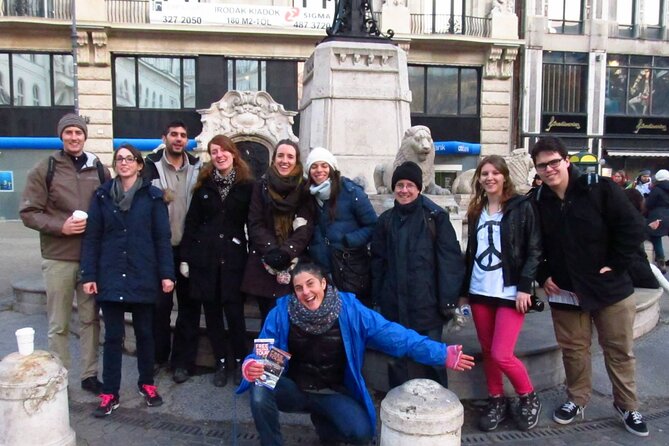
Meet your licensed local guide about 20 meters from the Budapest Eye in Erzsébet Square. Look for the small blue flag. This detail matters because the square has open space, nearby attractions, and plenty of people moving through it.
I would arrive early enough to identify the Budapest Eye first, then check the area close to it rather than wandering around asking for vague directions. One person who missed the walk had confusion over the guide’s clothing and an umbrella, although the official meeting information specifies a blue flag. If you cannot find the group, contact the operator before the scheduled departure, not after the walk has left.
The opening section sets expectations. The guide points out the route on a map and explains the main landmarks, along with some less obvious backstreets. This is a useful moment to decide what you want to revisit later.
The booking confirmation is issued at the time of purchase. The activity is offered in English, and the maximum group size is 30. Service animals are allowed, public transportation is nearby, and most people can take part, though you should be comfortable walking outdoors for roughly two hours.
St. Stephen’s Basilica and the food talk in its square
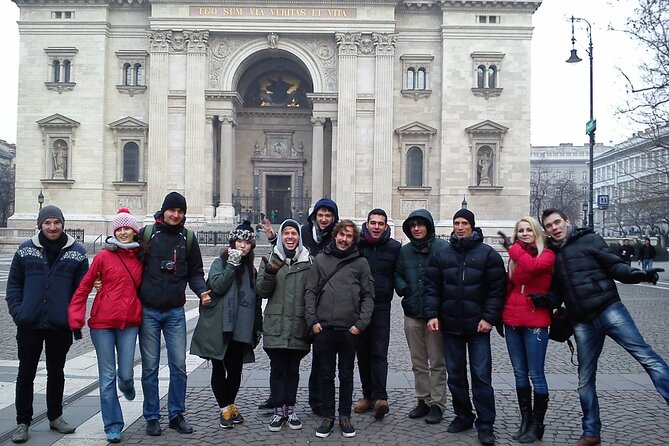
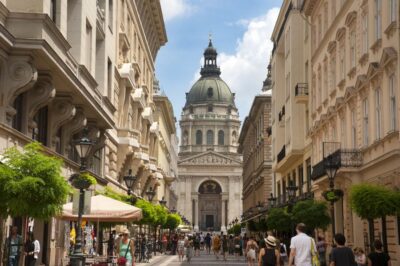
St. Stephen’s Basilica is one of Budapest’s essential landmarks. The guide explains its scale, including seating for about 8,500 people, and shows how its architecture reflects different periods of the city’s fortunes.
You do not go inside the Basilica on this experience. That is an important limitation if you want to see the interior, dome, or treasury. Instead, you get an exterior introduction and a look at the handsome buildings around the pedestrianized square.
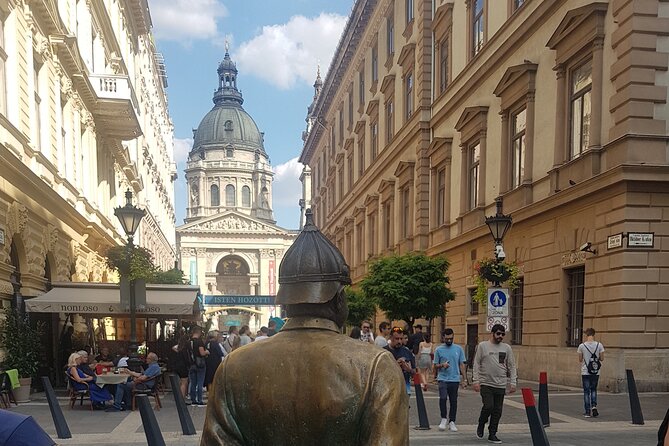
The next stop, St. Stephen’s Square, shifts from architecture to Hungarian food. Public art depicting portly policemen with shiny bellies provides an easy opening for a discussion of Hungarian cooking, local traditions, and what to eat in Budapest.
This is one of the tour’s more useful features. A short food talk can save you from ordering blindly later. You will also hear advice on avoiding tourist traps. The guide’s recommendations are not a substitute for your own taste, but they give you a starting point before you sit down for your first Hungarian meal.
Habsburg connections and Budapest’s decorative arts
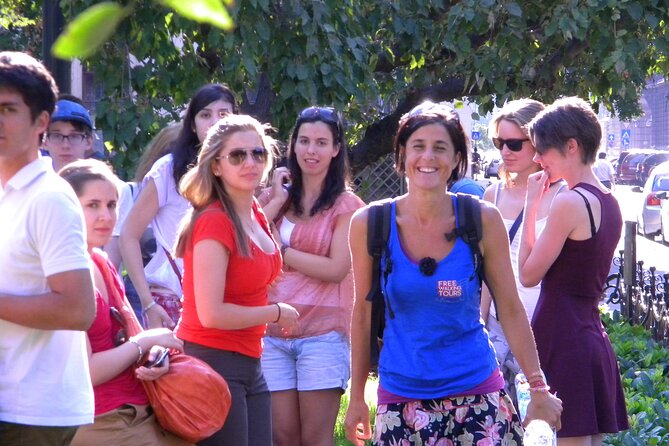
At József Nádor Square, the guide introduces the most Hungarian of the Habsburgs and adds a look at two important Hungarian decorative traditions.
Herendi porcelain is presented as some of the world’s most prestigious hand-painted porcelain. Zsolnay is known for beautifully glazed, colorful ceramics. Even if you do not plan to visit a museum or shop for ceramics, these details help you read Budapest’s grand façades and interiors with a more informed eye.
This stop is brief, so do not expect a full art lecture. Its value is in showing how Hungarian identity appears in design, craft, and the decorative arts, not only in political monuments.
A few more Budapest tours worth comparing
- Buda Hills 2-Hour Segway Live-Guided Tour
★ 5.0 · 218 reviews - Budapest: 2-Hour Private TukTuk Tour
★ 4.9 · 103 reviews - Budapest 2-Hour Night Segway Experience
★ 5.0 · 35 reviews - 2-Hour Private Night Tour of Budapest
★ 5.0 · 17 reviews
Vörösmarty Square, Váci utca, and the old café tradition
Vörösmarty Square is a good place for people-watching and sits at the end of Váci utca, Budapest’s famous pedestrian shopping street. The guide explains the square’s connection to the second-oldest underground railway in the world, whose line has one of its terminals nearby.
You also hear about the neo-classical buildings and Gerbeaud, the polished café associated with Budapest’s grand café culture. The square is especially useful for understanding the city as a meeting place, not just a collection of monuments.
Christmas markets and holiday traditions come into the conversation here. If you visit outside the winter season, the market details still provide a glimpse into how Budapest uses its public squares for food, crafts, and social life.
The stop is short, so you will not have time to settle into the café or explore the full length of Váci utca. Treat this as orientation. Mark the square on your map and return later if the setting appeals to you.
The Danube Embankment brings the best views
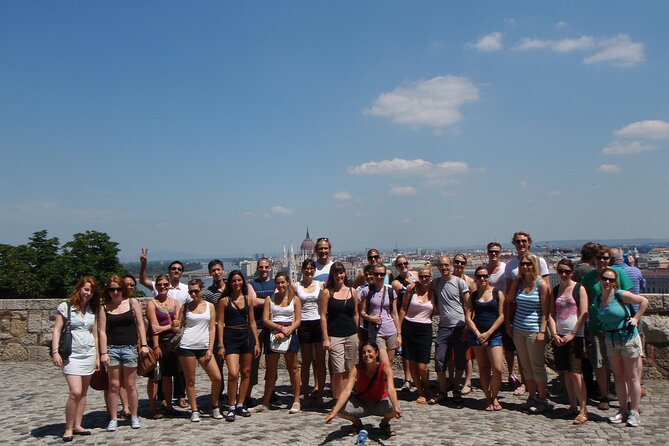
The walk becomes more scenic at the Korzó, the Danube embankment. Here, the guide points out the first non-Communist statue in Budapest, the riverside buildings, and what is described as Central Europe’s most panoramic tram line.
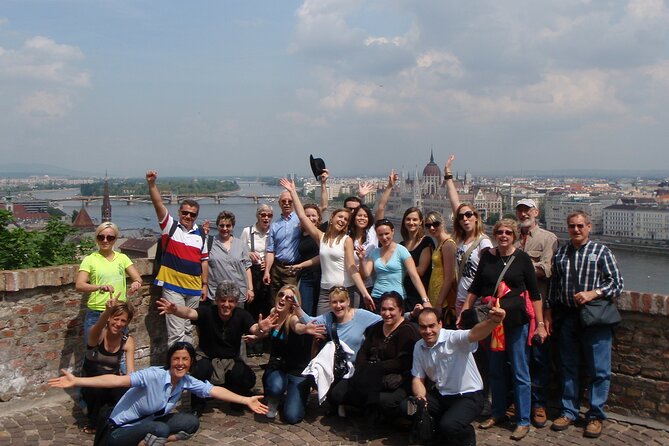
The views across the river are the reward. You can see Castle Hill, Matthias Church, Fisherman’s Bastion, Buda Castle, and Gellért Hill with its Citadel. Several of these sights form part of Budapest’s UNESCO-listed central view.
This is where I would pay close attention and take notes. The Buda side is often the next major area you explore, and seeing its layout from the Pest riverbank makes a later visit much easier. You can also decide which sights deserve a dedicated tour, rather than trying to see everything at once.
The riverfront can be exposed to sun, wind, or rain. One four-star comment specifically advises bringing a drink. That is sensible advice for any outdoor walk, especially if you are visiting in warm weather.
The Little Princess and Vigadó Square
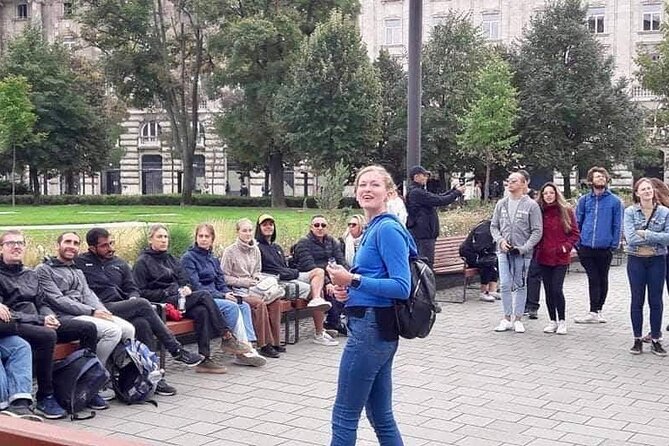
The Little Princess Statue provides a two-minute pause and a bit of playfulness. You are invited to touch the statue’s shiny knees while making a secret wish.
It is a small moment, but it breaks up the heavier historical material. The statue also gives you a simple photo opportunity without taking much time from the route.
At Vigadó Square, the guide explains the site’s connection to the coronation banquet held for Franz Joseph and Sissy in the 19th century. The square also recalls performances by major Central European musicians, including Franz Liszt, Debussy, and Brahms.
Again, these are quick introductions rather than full visits. You see the setting, hear why it matters, and can return later if you want more time with the building or riverfront.
The Chain Bridge explains Buda and Pest
At Széchenyi Chain Bridge, the guide tells the story of the first permanent bridge connecting Buda and Pest. The bridge is more than a pretty crossing. It helps explain how the two sides became one capital and why the Danube is central to Budapest’s identity.
The stop is short, but the subject is well chosen. You begin the walk learning how to place Budapest’s neighborhoods, and here you get the key piece of the city’s physical story.
The bridge also makes a fine photo stop, with views toward the hills and the river. You will not cross it as part of the stated route, so plan a separate walk across the bridge if that is on your list.
Gresham Palace shows Budapest’s Art Nouveau side
Gresham Palace offers a change of architectural mood. The guide introduces this ornate Secessionist building, created during Budapest’s golden age around the turn of the 20th century, and points out major elements of the Art Nouveau style.
This is the kind of stop that rewards looking upward and taking your time with details. Budapest can appear overwhelmingly grand at street level, but decorative features on a single façade often tell you much about the city’s ambition in that period.
The tour does not present Gresham Palace as a long interior visit. You are mainly learning how to recognize the style and understand the building’s place in the city’s development.
Hungarian inventions, famous names, and a few useful words
Near the Hungarian Academy of Sciences, the tour becomes more personal and interactive. The guide teaches simple Hungarian words and phrases, then explains why Hungary has a high number of Nobel Prize winners per capita.
You also hear about famous people of Hungarian origin and inventions associated with Hungary that you use in daily life. This part gives the city a human scale. Instead of treating Hungary as a distant chapter in European history, it connects the country to science, language, culture, and familiar objects.
The language lesson is likely to be light rather than formal. That is exactly right for a short city walk. You may not leave speaking Hungarian, but you can pick up a few expressions and a better sense of how unusual the language is for English speakers.
Guides such as Gary have been praised for including Hungarian language and local lore without slowing the walk. If you enjoy asking questions, this is a good place to do it.
Shoes on the Danube Bank asks for quiet attention
The Shoes on the Danube Bank memorial is the most serious stop. Sixty pairs of shoes line the riverbank in memory of Jewish people murdered here during the Holocaust.
The guide discusses World War II, deportations, and the more recent history of Hungary’s Jewish community. You are asked to pause and imagine the individuals represented by the memorial, from older people to children, factory workers to business owners, religious Jews to people who had assimilated into Hungarian society.
This section deserves respect and attention. The memorial is simple, direct, and emotionally difficult. The tour does not treat it as a quick photo backdrop. It places the shoes within the story of the people who were killed and the wider history of Budapest’s Jewish population.
If you prefer a lighter sightseeing experience, know that the final part of the route carries more emotional weight. That is not a flaw, but it is part of what gives the walk substance.
Parliament is a fitting final stop
The tour ends at the Hungarian Parliament Building on Kossuth Lajos Square. The guide discusses Hungary’s recent history, elections, and the building’s neo-Gothic architecture.
Parliament is one of the most recognizable sights in Budapest, and ending here gives the walk a clear finish. You have moved from public squares and churches to the river, then through memory and modern politics.
The guide provides final orientation and suggestions for restaurants, nightlife, and activities for your remaining days. Several guides are praised for practical recommendations, especially places away from the most tourist-focused streets. One participant used the advice to shape much of the rest of the visit, while another followed restaurant suggestions and enjoyed both choices.
You should write down these recommendations before the group breaks up. The end of a walking tour is often when useful details disappear into the general excitement of the next stop.
What the price really means
At $3.63 per person, this is an unusually inexpensive way to get a structured introduction to Budapest. The booking fee covers administration, not the guide’s earnings.
The guide depends entirely on donations at the end. You choose the amount, so think of the listed price as a reservation or administration charge rather than the complete cost. If the guide gives you a useful orientation, answers questions, and helps shape your stay, budget for a tip that reflects that value.
This arrangement can work well for people who want flexibility. You are not locked into a large fixed tour price, and the low booking cost makes it easy to add the walk to a short visit. The trade-off is that the final amount is partly up to you.
The route also gives good value in time. You spend about two hours, sometimes described as closer to two and a half, then have most of the day free. You see the main central sights without sacrificing an entire morning or afternoon.
Timing, group size, and the walking effort
The group can include up to 30 people. That is not a tiny private walk, so you should expect some gathering around the guide at busy squares and riverfront stops.
The good news is that several guides are praised for using a speaker or projecting their voices well. Marton, in particular, is noted for using a speaker so the group could hear easily. Still, stand close enough to follow, especially near roads or crowded public spaces.
The walking is described as easy, but the route covers many stops and requires you to remain outdoors. Wear comfortable shoes and bring water. Most people can participate, and service animals are allowed, but the experience is not designed around seated sightseeing or long indoor breaks.
A good weather requirement applies. If poor weather cancels the tour, you are offered another date or a full refund. You can cancel for a full refund up to 24 hours before the start time. Changes or cancellations inside that window are not accepted.
Who should book this Budapest walk
I would choose this tour if you are visiting Budapest for the first time and want a quick mental map before exploring on your own. It suits curious people who like history but also want food advice, local observations, and a few humorous details.
It is also a good fit if you are deciding between several Budapest activities. The route shows you what is worth a return visit, including the Basilica, the riverfront, the Chain Bridge area, Parliament, and the Buda skyline.
You may want something else if you already know central Pest well, want to enter every major building, or prefer a small private group. The Basilica is not entered, several stops are only a few minutes long, and the route offers breadth rather than detailed interior access.
Should you book it?
Book it for a cheap, useful first look at Budapest. The strongest reasons are the wide range of sights, the practical food and restaurant advice, and the guides’ repeated ability to make history clear and entertaining.
Arrive early at the Budapest Eye, look for the blue flag, bring water, and remember that a tip is the guide’s main source of earnings. If you want a gentle introduction that leaves the rest of your day open, this walk earns its place near the start of your Budapest plans.
FAQ
How long does the Budapest City Landmarks Walking Tour last?
The tour lasts approximately two hours, although the experience is also described as lasting around two and a half hours. The rest of your day remains free for further sightseeing.
Where does the walking tour start?
The meeting point is about 20 meters from the Budapest Eye in Erzsébet Square, Budapest 1051. Look for the licensed local guide holding a small blue flag.
Where does the tour finish?
The final stop is the Hungarian Parliament Building at Kossuth Lajos tér 1-3, Budapest 1055.
Is the tour offered in English?
Yes. The tour is offered in English.
Does the tour enter St. Stephen’s Basilica?
No. You learn about the Basilica and see the surrounding square, but admission inside the Basilica is not included.
How much does the tour cost?
The listed price is $3.63 per person. This is a booking fee for administration and does not contribute to the guide’s earnings. Tips are not included, and guides depend entirely on donations at the end.
How large can the group be?
The activity has a maximum of 30 participants.
What happens if the weather is poor?
The experience requires good weather. If it is canceled because of poor weather, you can choose another date or receive a full refund. You can also cancel up to 24 hours before the start time for a full refund.
Recently added around Budapest
- Hiking + Chairlift ride + viewpoints in Budapest★ 5.0 · 3 reviews
- FoolsCode: EscapeRoom/Sightseeing tour with Actor Tourguide★ 5.0 · 3 reviews
- Grand Budapest tour with private transportation★ 5.0 · 3 reviews
- Budapest: Private Customizable Tour in French★ 5.0 · 3 reviews
- Budapest: Private, Personalized Pub Crawl, 3 drinks included★ 4.5 · 3 reviews
- Budapest Drinks and Piano Show Cruise★ 4.5 · 3 reviews
- Discover Budapest Using Tram Two★ 5.0 · 3 reviews
- Budapest: Private 3-Hour Gödöllő Palace Tour★ 4.9 · 3 reviews
City Tours, compared.

City Sightseeing Hop-On Hop-Off Bus Tour & Extras
Read our review →

Hungarian Chimney Cake Workshop in the City Center
Read our review →


Private Budapest City tour with Classic Russian Jeep or G-Wagon!
Read our review →Browse the lists this tour appears in