
Reviewed · BUDAPEST
Hungary today: a no-taboo conversation
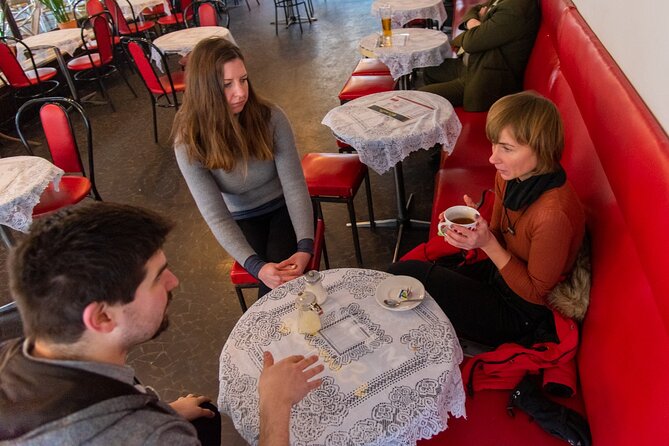
Hungary’s recent story is complicated, and this 90-minute conversation at Bambi Café gives you room to ask about the parts a standard city tour usually skips. You can hear about the move from Communism to democracy, today’s political system, economic concerns, and possible changes ahead.
I like the small maximum of six people, which should make a real exchange possible rather than a one-way talk. I also like the setting: Bambi Café has changed very little since the 1970s, so you are discussing modern Hungary in a place with its own link to the country’s past.
The main drawback is clear: this is not a sightseeing tour. If you want monuments, photographs, or a packed route through Budapest, spend your time elsewhere. The price is also fairly high for 90 minutes, so the value depends on how much you want a candid conversation.
In This Review
- Key points to know before booking
- Why this Budapest experience is different
- Bambi Café keeps the setting firmly in the past
- The opening gives you a base in Hungary’s last 30 years
- The second part puts your questions at the center
- What Daniel and Raymond bring to the experience
- Why six people is the right group size
- Is $40.52 good value for 90 minutes?
- Timing, meeting point, and practical details
- Who should book this conversation
- Questions worth bringing to Bambi Café
- My verdict on this candid Hungary experience
- FAQ
- Where does the experience begin?
- What time does the experience start?
- How long does the conversation last?
- Where does the experience end?
- How many people can join?
- What topics are covered?
- Do I need to prepare questions?
- Is the experience available with a mobile ticket?
- Can I cancel for a full refund?
Key points to know before booking

- A conversation, not a conventional tour: The focus is Hungary’s politics, economy, recent past, and future.
- Bambi Café provides the setting: This cult café has changed very little since the 1970s.
- Daniel and Raymond are named hosts: Daniel led one praised conversation, while Raymond answers for Budapest Explorers.
- Up to six people: The small group allows more space for personal questions.
- You help shape the session: Bring questions, or listen to an opening presentation on Hungary’s last 30 years.
- Easy afternoon timing: Meet at 2:00 pm and finish back at Bambi Café after about 90 minutes.
Why this Budapest experience is different
Most Budapest tours help you understand buildings, battles, kings, and grand avenues. This one asks a more direct question: how does Hungary work today, and how did it get here?
That makes the experience useful if you already know the basic sights or have spent enough time in Budapest to notice that official stories do not explain everything. You can ask about the shift from Communism to democracy, the country’s current political direction, economic pressures, and the idea of an illiberal democracy.
The format is deliberately open. The hosts explain that they will try to answer all questions, including controversial ones. You can ask about political decisions, the turbulent past, uncertain plans for the future, or the hosts’ own ideas for change.
I appreciate that promise because the subject needs room for uncertainty. Hungary’s modern era cannot be reduced to a list of dates or slogans. A conversation lets you test your assumptions and ask follow-up questions when something is unclear.
At the same time, you should know what you are buying. You are not booking a formal academic lecture, a guided walk, or a staged show. You are paying for access to local perspective and an honest exchange, with the quality shaped by your questions and the particular host leading the session.
Other Budapest outings people book alongside this one:
- Budapest: City Highlights Cruise with Welcome Drink
★ 4.6 · 35,610 reviews - Budapest: Unlimited Prosecco, Beer and Aperol Spritz Cruise
★ 4.8 · 25,310 reviews - Budapest: Széchenyi Spa Day Ticket with Optional Upgrades
★ 4.3 · 23,911 reviews
Bambi Café keeps the setting firmly in the past
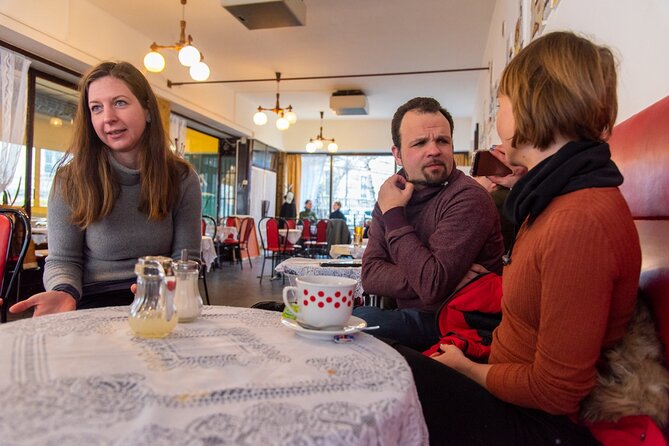
The meeting point is Bambi Café at Frankel Leó út 2-4, in Budapest’s 1027 postal district. The café is described as a cult spot that has changed close to none since the 1970s.
That detail matters. The conversation concerns the years after Communism, but the walls and atmosphere offer a quiet reminder of the older system. You are not discussing political change inside a polished modern visitor center. You are sitting in a café connected to an earlier Budapest.
The information does not specify a reserved room, private table, or included drink. I would treat the café as the meeting setting, not assume that refreshments are part of the $40.52 price. If you want coffee or food, confirm the arrangement when booking.
Bambi Café also makes this experience more than a video call with a local host. The location gives you a concrete place to meet, and the activity finishes there as well. You will not need to follow a complicated route through the city while trying to keep up with a discussion.
The opening gives you a base in Hungary’s last 30 years
If you arrive without a list of questions, the host begins with an introduction to Hungary’s modern era. The first part focuses mainly on historical, economic, and political subjects from the last 30 years.
That is a sensible starting point. You need some context before asking why current politics looks the way it does. The move from Communism to democracy is not just background information here. It is the key transition that frames the rest of the discussion.
The opening also helps you decide where to take the conversation. You might begin with a broad question about democratic change, then move toward economics or the current government. Or you may discover that your original question was based on an oversimplified idea.
Because the session lasts about an hour and a half, the opening cannot cover every aspect of recent Hungarian life. It should give you enough grounding to make the rest of the time useful. If you want detailed preparation, read a little about Hungary’s post-Communist period before you arrive.
The second part puts your questions at the center
After the introduction, the format shifts into a more open discussion. This is the strongest reason to book the experience. You are encouraged to ask what you have always wanted to know about Hungary.
The stated topics are wide-ranging. They include controversial politics, the country’s past, its uncertain future, the economy, personal opinions, and possible ideas for change. That breadth means the session can feel very different depending on the people in the group.
You may prefer a focused exchange about political institutions. You may want to understand how economic changes affect ordinary life. You may be curious about how Hungarians view the country’s direction, or how a local person explains the transition from one political system to another.
The hosts do not present the discussion as neutral in the narrow sense of avoiding all opinions. The experience promises their opinions, too. That can be valuable, provided you remember that a host’s view is personal rather than a complete account of every Hungarian perspective.
I suggest preparing three or four questions. Start with the subject you care about most, since a lively exchange can use the available time quickly. Leave room for follow-up questions instead of bringing a long checklist.
A different kind of day in Budapest:
- Budapest: Nighttime or Daytime Sightseeing Cruise
★ 4.2 · 21,062 reviews - Budapest: 1-Hour Evening Sightseeing Cruise with Drink
★ 4.5 · 8,330 reviews - Budapest Danube Cruise and Dinner Options, Live Music and Dance
★ 4.5 · 7,428 reviews - Budapest: Historic Cruise with Welcome Drink
★ 4.7 · 6,512 reviews
What Daniel and Raymond bring to the experience
Daniel is specifically identified as a host for this experience. The strongest praise directed at him describes a friendly, informative conversation that could easily have continued for several more hours.
That is useful information for you because this format depends heavily on the person at the table. Daniel appears to be comfortable explaining contemporary Hungary and responding to questions rather than simply reciting prepared material.
Raymond is also connected with Budapest Explorers and responds on behalf of the experience. The available information does not promise that Daniel will lead every date, so check the host details if meeting a particular person matters to you.
Another earlier session included a Hungarian woman described as having a broad grasp of her own country and the wider world. Her name is not provided, so I would not assume she will be your host. The practical point is that the experience may feature different people, each with a personal way of handling difficult subjects.
That uncertainty is not necessarily a flaw. It simply means you should book this for the format and topic, not for a guaranteed celebrity guide or fixed script.
Why six people is the right group size
The maximum is six participants. For a political conversation, that is a strong practical feature.
A large group can turn sensitive questions into a lecture. With six people, you have a better chance to ask a follow-up, hear another person’s angle, and keep the exchange moving. The group is still large enough to bring different interests to the table, but small enough for the host to respond directly.
The actual number on your date may be lower, but that is not specified. Do not count on a private conversation unless the operator confirms it. The six-person limit means small-group, not necessarily one-on-one.
The subject also benefits from a mixed group. One person may ask about elections, another about the economy, and someone else about daily life under changing political rules. Those different questions can expose parts of Hungary’s current situation that you would not think to ask about yourself.
If you prefer to listen quietly, you can do that. Still, the activity will be most rewarding if you take part. The hosts have built the experience around openness, not passive sightseeing.
Is $40.52 good value for 90 minutes?
At $40.52 per person, this is not a cheap café stop. You can spend far less on a coffee, a museum ticket, or a self-guided walk through Budapest.
The value comes from the access and the format. You are paying for a small group, a host who can explain Hungary’s recent political and economic changes, and the chance to ask questions that may not fit into a standard tour. If that is exactly what you want, the price can be reasonable.
I would compare it with the cost of a longer sightseeing tour only with care. A traditional tour may give you several hours of sights, transport, and structured information. This experience gives you about 90 minutes in one place, but it offers something those tours usually cannot: direct discussion about present-day Hungary.
The price is harder to justify if you know little about Budapest and have limited time in the city. In that case, I would first visit the major sights and get a basic sense of the country. This conversation makes more sense once you have some questions of your own.
Since admission to Bambi Café is free, the charge is clearly for the hosted experience rather than entry to the café. The supplied details do not say that food or drinks are included, so budget separately for anything you order.
Timing, meeting point, and practical details
The start time is 2:00 pm. The activity lasts about one hour and 30 minutes and ends back at Bambi Café.
That afternoon schedule is easy to fit around a morning museum visit or an evening program. You should arrive at Frankel Leó út 2-4 before 2:00 pm, since the experience is built around a punctual group conversation rather than a moving route where you can catch up later.
The café is near public transportation. The details do not name a specific tram, bus, or metro line, so check your route before setting out. A mobile ticket is provided, and confirmation arrives at booking.
Most people can participate, and service animals are allowed. The experience is not described as a strenuous activity, but the supplied information does not give details about seating, step-free access, or restroom facilities. Contact Budapest Explorers if those points affect your booking.
Free cancellation is available if you cancel at least 24 hours before the local start time. A cancellation made within 24 hours, or a change requested during that period, is not accepted for a refund.
Who should book this conversation
I would choose this for someone who wants to understand Hungary beyond the postcard view of Parliament, the Danube, and grand cafés.
It suits you especially well if you:
- Have visited Budapest before
- Know a little about Hungary’s modern history
- Want to discuss current politics without avoiding difficult subjects
- Prefer a small group to a large guided tour
- Enjoy asking questions and hearing personal opinions
- Have time for a focused 90-minute conversation
It may also work for a first-time visitor who is already interested in Central European politics. But if your main goal is to see Budapest, this should be an addition to your sightseeing, not a replacement for it.
Families with young children may find the subject and format demanding, though the information does not set an age restriction. Anyone booking should be ready for a serious conversation rather than entertainment built around constant movement.
Questions worth bringing to Bambi Café
You do not need to prepare a speech. A few clear questions will help you get more from the time.
You could ask how the shift from Communism to democracy changed ordinary life, what economic issues matter most today, or how the phrase illiberal democracy is understood in Hungary. You might ask the host to separate public policy from personal opinion, or to explain which changes are most important for the country’s future.
You can also ask about the past if that is what interests you. The experience specifically welcomes questions about Hungary’s turbulent history, so you do not need to limit yourself to current headlines.
The best questions are open enough to invite explanation. Instead of asking only if something is good or bad, ask how it developed, who supports it, and what might change it. That gives the host more room to offer useful context.
My verdict on this candid Hungary experience
Book it if you want a direct discussion about modern Hungary and value access to a local point of view more than a long list of sights. The six-person limit, open question format, and unusual Bambi Café setting give the experience a clear purpose.
I would skip it if you have only one short day in Budapest, dislike political discussion, or expect a conventional walking tour. For the right audience, though, this can add meaning to everything else you see in Hungary. It helps you connect the old café, the post-Communist transition, and today’s unsettled questions in one focused conversation.
FAQ
Where does the experience begin?
It begins at Bambi Café, Budapest, Frankel Leó út 2-4, 1027 Hungary.
What time does the experience start?
The start time is 2:00 pm.
How long does the conversation last?
The experience lasts approximately one hour and 30 minutes.
Where does the experience end?
It ends back at Bambi Café, the meeting point.
How many people can join?
The maximum group size is six people.
What topics are covered?
The discussion can cover Hungary’s recent past and present, the move from Communism to democracy, politics, economics, the idea of an illiberal democracy, the country’s future, personal opinions, and possible ideas for change.
Do I need to prepare questions?
No. If you do not have specific questions, the host gives an introduction to Hungary’s modern era, focused mainly on the last 30 years and historical, economic, and political issues.
Is the experience available with a mobile ticket?
Yes. A mobile ticket is provided.
Can I cancel for a full refund?
Yes, if you cancel at least 24 hours before the experience’s local start time. Cancellations or changes made less than 24 hours before the start are not accepted for a refund.
Recently added around Budapest
- Hiking + Chairlift ride + viewpoints in Budapest★ 5.0 · 3 reviews
- FoolsCode: EscapeRoom/Sightseeing tour with Actor Tourguide★ 5.0 · 3 reviews
- Grand Budapest tour with private transportation★ 5.0 · 3 reviews
- Budapest: Private Customizable Tour in French★ 5.0 · 3 reviews
- Budapest: Private, Personalized Pub Crawl, 3 drinks included★ 4.5 · 3 reviews
- Budapest Drinks and Piano Show Cruise★ 4.5 · 3 reviews
- Discover Budapest Using Tram Two★ 5.0 · 3 reviews
- Budapest: Private 3-Hour Gödöllő Palace Tour★ 4.9 · 3 reviews