
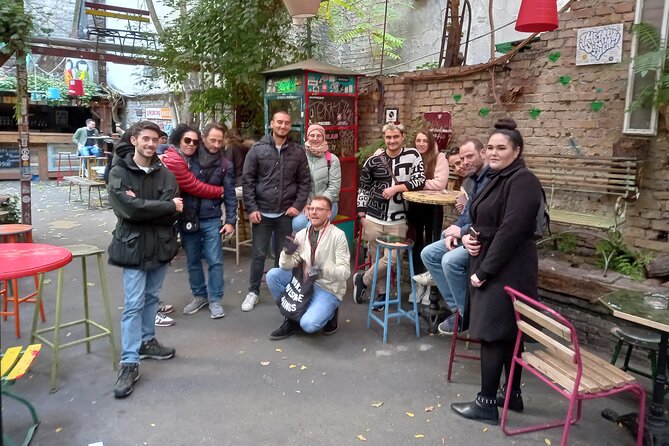
Reviewed · STREET ART
Street Art and Alternative Tour in Budapest
Budapest’s street art is not limited to big painted walls. On this two-hour walking tour, guide ET points out stickers, small objects, murals, sculptures, and political images tucked along the narrow streets of District VII. I like that the tour treats street art as a way to read the city, not just as a backdrop for photos.
I especially like the small group of up to eight people, which gives you room to ask questions and discuss what you see. I also like the route from Telep-Art Galéria to Szimpla Kert, since it finishes at one of Budapest’s best-known ruin bars. The main drawback is simple: there is plenty of walking, and the focus is often on ideas and social messages rather than only on beautiful paintings.
In This Review
- Key points at a glance
- Reading Budapest through its street art
- Meeting at Telep-Art Galéria
- Walking the narrow streets of District VII
- ET’s approach to art, politics, and local change
- What makes this route different
- The finish at Szimpla Kert
- Price, group size, and overall value
- Walking demands and practical planning
- Who will enjoy this tour most
- Why the guide matters here
- Should you book the Street Art and Alternative Tour?
- FAQ
- How long is the Street Art and Alternative Tour in Budapest?
- What language is the tour offered in?
- Where does the tour begin?
- Where does the tour end?
- How many people can join the tour?
- What types of street art can I see?
- Can I cancel for a full refund?
Key points at a glance
- ET leads the walk: He is active in Budapest’s art scene and explains both the artwork and the local history behind it.
- District VII is the setting: You walk through thin streets and less familiar corners near the city’s famous ruin-bar district.
- Street art takes many forms: Expect murals, stickers, bronze sculptures, smart-art images, and small pieces that are easy to miss.
- The tour is interactive: The guide welcomes questions and adjusts the discussion to the group.
- Eight people maximum: The limited size makes conversation easier than on a large city tour.
- The finish is Szimpla Kert: You end at Budapest’s oldest ruin bar, a useful place to continue exploring on your own.
Reading Budapest through its street art
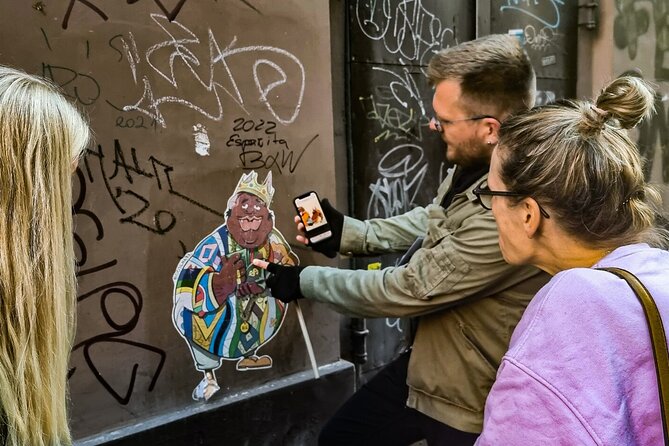
The most useful idea here is learning how to look. Budapest’s street art is not always a giant wall painting that announces itself from across the street. Some pieces are tiny. Others sit on utility boxes, shopfronts, corners, or walls you might pass without a second glance.
ET slows the pace so you can notice those details. You are not simply walking from one famous sight to another. You stop, look closely, and discuss what the piece might be saying. This makes the experience different from a standard sightseeing walk, where the main goal is often to cover as much ground as possible.
The art also gives you another way to understand District VII. The area is closely tied to Budapest’s nightlife and ruin bars, but the tour pays attention to its creative and political side. You may see work shaped by current events, public debate, social questions, and the changing character of the neighborhood.
That last point matters. The tour is not sold as a parade of pretty murals. Some of the most interesting pieces may be rough, small, or deliberately provocative. If you enjoy asking why an artwork exists, who it is speaking to, and what it says about public life, you will get more from this walk than someone looking only for polished photographs.
More street art walks in Budapest:
- Budapest: Street Art and Underground Movements Walking Tour
★ 5.0 · 238 reviews - Alternative Street Art Free Walking Tour of Budapest
★ 4.5 · 53 reviews - Budapest: Alternative Street Art & Jewish Tour
★ 4.8 · 49 reviews
Meeting at Telep-Art Galéria
The tour begins at Telep-Art Galéria, at Madách Imre út 8 in the 1075 district. This gives the experience an art-focused starting point rather than a conventional landmark such as Parliament or St. Stephen’s Basilica.
You should allow time to find the meeting point. The supplied directions identify the gallery clearly, but the tour depends on arriving at the stated start location, so checking the address before setting out is sensible. The tour is offered in English, and confirmation is provided when you book.
Starting near an art gallery also helps set expectations. This is a local, creative-area walk. You are not signing up for a broad introduction to every major Budapest sight. The value comes from the guide’s close attention to small details and his ability to connect them to the surrounding neighborhood.
Walking the narrow streets of District VII
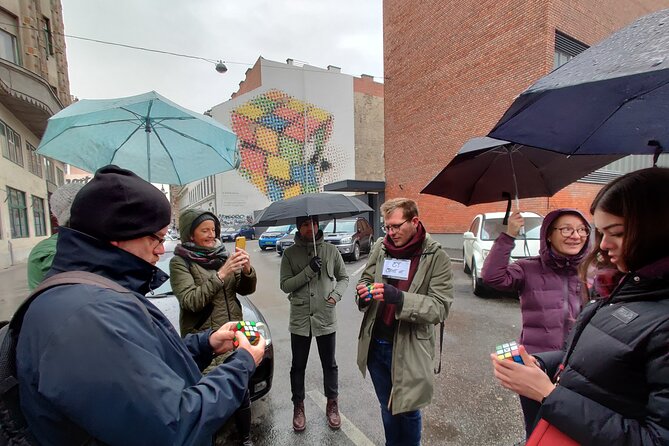
The route is done on foot and moves slowly through narrow streets. That slower pace is important. Street art rewards careful looking, and rushing from one stop to the next would defeat the purpose.
You can expect to see several forms of public art during the walk:
- Large wall murals
- Small stickers and pasted images
- Bronze sculptures
- Smart-art images
- Street objects and altered street fixtures
- Pieces with political or social messages
The variety keeps the route from feeling repetitive. One stop may be a large work that changes the feel of a wall. The next may be a small sticker or box that requires you to stand close and examine it. The guide’s role is especially useful here, because many works are easy to overlook even when they are directly in front of you.
One particularly useful result is that you learn where to look after the tour ends. Instead of seeing only the obvious murals, you may begin scanning boxes, corners, doors, and walls throughout Budapest. That new habit is part of the experience’s lasting value.
ET’s approach to art, politics, and local change
ET is the central reason this tour feels more personal than a self-guided walk. He is involved in Budapest’s art scene and brings enthusiasm to the subject. He also connects the work to the history of the area and to changes taking place in the district.
The discussion can include political events and the ways artists respond to them. One of the strongest aspects of the walk is that it does not force every piece into a simple good or bad interpretation. You are encouraged to think about what the artist is communicating and how public art can question the world around it.
ET also knows about street artists from across Europe, so the conversation can reach beyond Budapest. He may share additional art resources and social-media pages for people who want to keep exploring after the walk. That is a useful touch for anyone who is already interested in contemporary art.
The tour is interactive rather than lecture-heavy. Questions are welcome, and the conversation can change depending on the group. On quieter weekdays, ET may tailor the discussion more closely to the people attending. With a maximum of eight people, it is easier to take part instead of standing at the back of a large crowd.
A different kind of day in Budapest:
- Budapest: City Highlights Cruise with Welcome Drink
★ 4.6 · 35,610 reviews - Budapest: Unlimited Prosecco, Beer and Aperol Spritz Cruise
★ 4.8 · 25,310 reviews - Budapest: Széchenyi Spa Day Ticket with Optional Upgrades
★ 4.3 · 23,911 reviews - Budapest: Nighttime or Daytime Sightseeing Cruise
★ 4.2 · 21,062 reviews
What makes this route different
A standard city tour often explains a building, monument, or famous event. This walk explains the city through unofficial marks and creative responses. That can reveal parts of Budapest that are not obvious from a guidebook route.
The tour is also a good choice for a first day in the city. It helps you learn how the central districts work on foot while giving you a creative introduction to Hungarian culture. You will not receive a complete history of Budapest in two hours, but you can gain a sharper sense of how people use public space and how the city’s artistic community comments on daily life.
Families can take part, and the tour suits a wide range of ages. Still, the exact appeal depends on your interests. Art students, creative people, politically curious visitors, and anyone who likes unusual city walks are the clearest match. If you want a relaxed stroll with no serious discussion, this may feel more thoughtful than expected.
The finish at Szimpla Kert
The walk ends at Szimpla Kert on Kazinczy Street. It is described as Budapest’s oldest ruin bar and one of the city’s symbols.
That ending works well. After spending two hours looking at the less obvious side of District VII, you finish in a place strongly associated with the area’s alternative culture. You can stop for a drink or use the location as a base for continuing your own evening, though the tour itself ends there.
Do not confuse the finish with a guided visit inside the bar. The stated route ends at Szimpla Kert, so any further time there is your own. It is still a practical endpoint, especially if you plan to explore District VII’s nightlife afterward.
Price, group size, and overall value
The price is $36.20 per person. For a two-hour walk, that is more than a basic free city stroll, but the comparison is not quite fair. You are paying for a specialist subject, a small group, and a guide who can explain details you would probably miss alone.
The group limit of eight is a real part of the value. A large street-art tour can turn into a procession, with people straining to hear and crowding around each stop. Here, you have a better chance to ask about a particular image, raise a different interpretation, or follow up on the politics behind a piece.
The price makes the most sense if you want something beyond Budapest’s major sights. It is less compelling if you have only a short time in the city and need a broad orientation tour. In that case, a general Budapest walk may cover more ground and give you more essential landmarks.
The tour is often booked about 25 days ahead. That suggests you should not leave it until the last moment if the small group is important to you. Free cancellation is available when you cancel at least 24 hours before the start time. Cancellations or changes inside that window are not accepted for a refund.
Walking demands and practical planning
This is a walking experience, not a ride between stops. The pace is slow, but the route still involves moving through city streets for about two hours. Wear comfortable shoes, and plan for ordinary outdoor conditions.
The tour is near public transportation, so reaching the meeting point should fit easily into a Budapest sightseeing day. The start and finish are both in the 1075 area, which keeps the route focused instead of sending you across the city.
Service animals are allowed, and most people can participate. The supplied information does not describe the exact street surfaces, seating, or toilet access, so you should contact the operator if you have specific mobility needs or require further access details.
Because the art is part of the public streetscape, the precise works seen can change. Pieces may be removed, painted over, or replaced. That is not a flaw in the concept. It is part of the nature of street art, but it means you should think of the route as a conversation about the district rather than a fixed museum collection.
Who will enjoy this tour most
I would choose this experience for you if you enjoy:
- Contemporary art and creative subcultures
- Political or socially minded artwork
- Exploring neighborhoods away from the main monuments
- Small groups and direct conversation with a guide
- Walking tours that leave you with a new way to look at a city
- Budapest’s ruin bars and District VII atmosphere
It is also a strong choice for artists and people who want to meet others with similar interests. The small group can create a friendly, conversational mood, and the discussion may benefit from different nationalities and points of view.
Families can join, too. The subject is accessible, and art does not require specialist training. Still, parents should be comfortable with the amount of walking and with discussion of political or critical themes.
I would be more cautious about booking it if you are mainly searching for grand architecture, formal art museums, or a complete overview of Budapest. The tour is narrow by design. Its strength is its focus.
Why the guide matters here
A street-art route without context can become a hunt for colorful walls. ET adds the part that makes the walk worthwhile: interpretation.
He explains the message behind the work, points out art that is easy to overlook, and places it within the local area. His background in Budapest’s art scene also helps connect the pieces to wider European street-art movements.
The guide’s personal energy is another practical factor. This is a subject that depends on curiosity and conversation. A quiet, purely factual presentation would make the small pieces and political references harder to appreciate. ET’s enthusiasm helps keep the route moving, even when the artwork is subtle rather than spectacular.
Should you book the Street Art and Alternative Tour?
Book it if you want to see Budapest from a less polished, more questioning angle. The best parts are the small group, ET’s personal connection to the art scene, and the chance to understand stickers, murals, sculptures, and other works as comments on the city.
The $36.20 price is fair for a specialist two-hour walk with only eight people, especially if you value conversation and local interpretation. Just bring good walking shoes and realistic expectations. This is not a greatest-hits tour of Budapest’s landmarks, and not every stop will be a beautiful mural.
For artists, curious first-time visitors, politically minded people, and anyone who likes alternative city experiences, this is an excellent choice. If you would rather spend two hours inside a museum or checking off famous buildings, save your money for another activity.
FAQ
How long is the Street Art and Alternative Tour in Budapest?
The tour lasts approximately two hours.
What language is the tour offered in?
The tour is offered in English.
Where does the tour begin?
It begins at Telep-Art Galéria, Madách Imre út 8, 1075 Budapest, Hungary.
Where does the tour end?
The tour ends at Szimpla Kert, Kazinczy u. 14, 1075 Budapest, Hungary.
How many people can join the tour?
The group is capped at eight people.
What types of street art can I see?
The experience can include murals, stickers, bronze sculptures, smart-art images, and other small or large works found along the streets.
Can I cancel for a full refund?
Yes. You can cancel at least 24 hours before the start time for a full refund. Cancellations or changes made less than 24 hours before the start time are not accepted for a refund.
Recently added around Budapest
- Hiking + Chairlift ride + viewpoints in Budapest★ 5.0 · 3 reviews
- FoolsCode: EscapeRoom/Sightseeing tour with Actor Tourguide★ 5.0 · 3 reviews
- Grand Budapest tour with private transportation★ 5.0 · 3 reviews
- Budapest: Private Customizable Tour in French★ 5.0 · 3 reviews
- Budapest Drinks and Piano Show Cruise★ 4.5 · 3 reviews
- Discover Budapest Using Tram Two★ 5.0 · 3 reviews
- Budapest: Private, Personalized Pub Crawl, 3 drinks included★ 4.5 · 3 reviews
- Budapest: Private 3-Hour Gödöllő Palace Tour★ 4.9 · 3 reviews
Street Art, compared.
Street Art and Underground Movements Walking Tour
Read our review →
Alternative Street Art Free Walking Tour of Budapest
Read our review →

Budapest Vibe: Ruin Bars, Street Art and Culture Tour
Read our review →

Budapest Urban Art – Private Street Art Tour with a Drink in a Ruin Bar
Read our review →Browse the lists this tour appears in