
Reviewed · BUDAPEST IMMERSIVE & VR EXPERIENCES
Cinematic Virtual Reality City Tour in a Russian Jeep
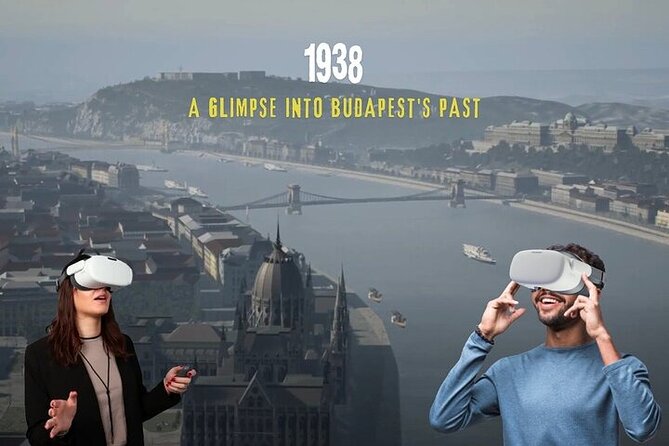
Budapest’s past becomes a moving picture on this unusual two-hour tour. You ride in a Russian Jeep, stop at major sights, then put on a VR headset to watch short 2D cinematic scenes that show how places such as the Chain Bridge, Buda Castle, and Blaha Lujza Square looked in earlier times. It is part sightseeing ride, part portable history lesson.
I like the private format, since your group gets its own vehicle and English-speaking guide rather than following a large crowd. I also like the mix of old and new: a military-style UAZ, modern VR gear, and some of Budapest’s grandest monuments. The main drawback is that several stops are brief, and this is not a substitute for going inside every major attraction.
In This Review
- Key points at a glance
- A Russian Jeep with a time machine inside
- Castle Hill: gardens, lions, and wide city views
- Buda Castle and the story of royal Budapest
- Parliament, St. Stephen’s Basilica, and the Danube side
- Andrássy Avenue and Budapest’s cultural landmarks
- Heroes’ Square and a look at lost Budapest
- The old Erzsébet Bridge and Budapest’s changing cityscape
- What the two hours feel like
- Is a $3 tour really good value?
- Who should book this Budapest tour?
- Should you book the Russian Jeep VR tour?
- FAQ
- How long does the Cinematic Virtual Reality City Tour last?
- What transportation is used?
- Is hotel pickup and drop-off included?
- Is the tour private?
- Is an English-speaking guide included?
- Are attraction admission fees included?
- Is the VR equipment suitable for everyone?
Key points at a glance
- Russian UAZ Jeep: The vehicle is part of the experience, not just a way to get from one sight to the next.
- Cinematic VR at landmarks: Short 2D films help you picture lost buildings, former bridges, and earlier versions of Budapest.
- Private English-speaking guide: You travel with your own group, with time for questions and local explanations.
- Strong first-time route: The tour covers Castle Hill, the Danube, Parliament, Andrássy Avenue, Heroes’ Square, and central squares.
- Hotel pickup and drinks included: Bottled water is provided, with hot tea in winter, and pickup and drop-off are included.
- Very low listed price: At $3, the value looks exceptional, but check the final booking total and inclusions before paying.
A Russian Jeep with a time machine inside
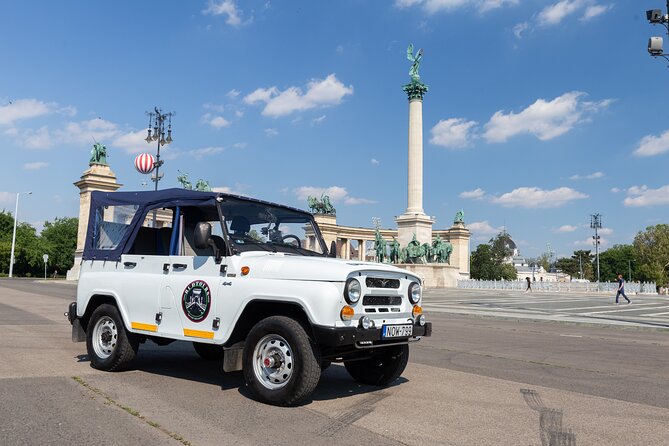
The UAZ Jeep gives this tour a different feel from a standard minibus circuit. It is an old-style Russian vehicle with its own character, and one passenger even connected it with childhood memories of a family vehicle. You are not simply being driven between monuments. The ride itself becomes part of the story.
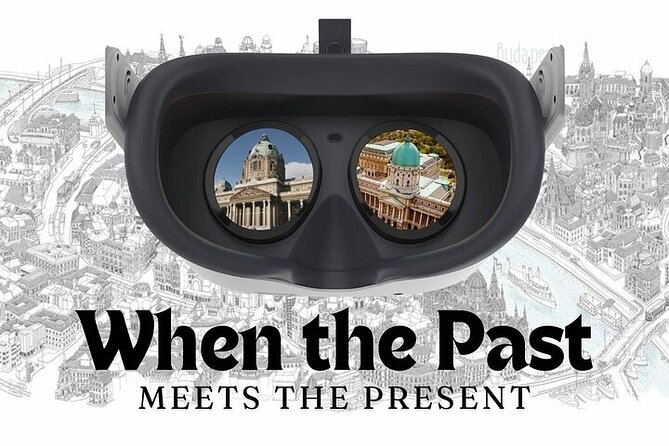
At selected stops, you use a VR headset to watch a cinematic recreation or historical view. The material is described as 2D rather than a fully interactive game, so think of it as a film placed at the real location. That distinction matters. You are not exploring a digital Budapest freely, but you are getting a quick visual comparison between the city you see now and the city that once occupied the same ground.
The private setup works well for families, couples, or small groups with mixed interests. Someone who enjoys architecture can ask about the buildings, while children may respond more strongly to the headset and the unusual Jeep. The English-speaking guide adds the connecting thread, explaining what you are seeing instead of leaving the VR footage to carry the whole experience.
A guide named Zsombor has been praised for being funny, attentive, and willing to answer questions. Since guide assignments can vary, treat that as a useful possibility rather than a guarantee. The important point is that the driver-guide role can make the ride feel personal, especially when you want to ask about Budapest beyond the prepared script.
More immersive and VR rooms:
- Budapest: Light Art Museum – Immersive New Media Experience
★ 3.9 · 1,269 reviews - IKONO Budapest – Immersive Experience
★ 4.5 · 626 reviews - Virtual Reality Walking Tour
★ 5.0 · 434 reviews
Castle Hill: gardens, lions, and wide city views
The route begins around the Castle Garden Bazaar, a Neo-Renaissance complex below Buda Castle. The gardens and buildings were designed to lead toward the royal palace, and today the area is used for exhibitions, concerts, and other cultural events. The scheduled stop is short, about three minutes, so use it to get oriented and enjoy the setting rather than expecting a full visit.
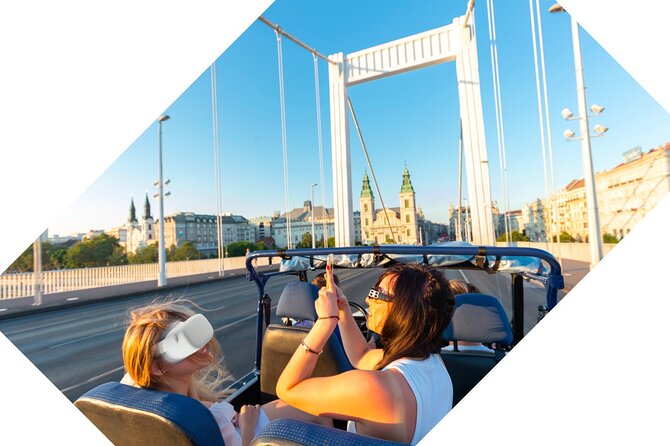
At the Chain Bridge, the focus shifts to one of Budapest’s most recognizable engineering landmarks. The bridge links Buda and Pest across the Danube and is watched over by its famous stone lions. The stop near the lion statues lasts about five minutes, with the VR film supplying the extra context.
This is a smart place for the time-travel idea. The bridge has changed in appearance and condition over the decades, and a historical film can show those changes more clearly than a spoken explanation alone. You will still want to look up from the headset for the river, hills, and city traffic, since the present-day view is part of the appeal.
The Fisherman’s Bastion gets about 15 minutes. Its towers and terraces look medieval, but the structure was built in the early 20th century as part of celebrations marking Hungary’s thousand years. That makes it a useful reminder that Budapest often presents newer buildings in an old-world style.
The lower sections are free, while the upper level requires an admission fee. The tour does not include that charge, so you may need to stay in the free areas unless you choose to pay separately. Even without the upper terrace, the location offers some of the best views across the Danube toward Pest.
Matthias Church is another 15-minute stop, but admission is not included. Its interior is known for a striking blend of oriental decoration, Romantic historicism, and Neo-Gothic design. If the church is a priority, budget for the ticket and confirm how much of the visit fits within the tour’s schedule.
Buda Castle and the story of royal Budapest
Buda Castle crowns Castle Hill and anchors the Castle Quarter, an area shaped by medieval, Baroque, and Neoclassical buildings. The palace once housed Hungarian kings, while the surrounding streets include old houses and churches. The VR presentation gives this stop more than a quick exterior view by showing how the royal center developed over time.
The value here is context. A first visit to Castle Hill can feel like a collection of handsome facades and viewpoints. Historical footage can help you connect the palace, the hill, and the surrounding quarter into one larger story. Still, the tour format gives you an overview, not a full museum visit. If you want palace interiors or long walks through the quarter, return later on your own.
This part of Budapest also includes slopes, steps, and uneven historic streets. The tour is designed so most people can participate, but you should still expect some standing and short walks at the stops. Service animals are allowed, and the activity is near public transportation if you decide to continue exploring after drop-off.
Parliament, St. Stephen’s Basilica, and the Danube side
The Jeep passes the Hungarian Parliament Building on Kossuth Square. The building sits beside the Danube and is the home of Hungary’s National Assembly. Its Neo-Gothic design, scale, and riverside position make it one of the city’s essential sights.
The Parliament portion is listed as a pass-by of about five minutes, not an interior tour. That is an important distinction. You will get a moving exterior view and historical explanation, but you will not receive a Parliament admission ticket or a guided walk through its halls.
St. Stephen’s Basilica also appears along the route. The church honors Hungary’s first king and is the largest church in Budapest, as well as the third largest in Hungary. It is also recognized as part of a World Heritage setting. Like Parliament, it works best here as an exterior landmark within a wider city circuit, unless you return separately for a longer visit.
These stops help balance the tour. Castle Hill gives you older royal Budapest, while Parliament and the basilica show the city’s grand civic and religious architecture. You get a broad sense of how the two sides of the river fit together, even though the schedule does not allow extended time at every building.
A few more Budapest tours worth comparing
- Budapest: City Highlights Cruise with Welcome Drink
★ 4.6 · 35,610 reviews - Budapest: City Sightseeing Hop-On Hop-Off Bus Tour & Extras
★ 4.1 · 4,337 reviews - Budapest City Landmarks Walking Tour in 2 Hours
★ 5.0 · 2,048 reviews - Budapest: Danube River City Lights Express Cruise
★ 4.1 · 1,608 reviews
Andrássy Avenue and Budapest’s cultural landmarks
The route continues along Andrássy Avenue, a grand boulevard lined with Neo-Renaissance buildings. The avenue is recognized as a UNESCO World Heritage Site and includes shops, cafés, restaurants, and several cultural institutions.
You get about 15 minutes here. That is enough for a look at the architecture and a short orientation, but not enough to explore the full avenue on foot. The boulevard includes the Hungarian State Opera House, the Zoltán Kodály Memorial Museum, the Hungarian University of Fine Arts, and the Ferenc Hopp Museum of East Asian Arts. Think of this stop as a preview of an area worth revisiting.
The Hungarian State Opera House receives about five minutes. Its exterior has a symmetrical Neo-Renaissance design with composer statues, while the interior is decorated with marble sphinxes, frescoes, and gold details. Admission is not included, and the tour does not promise an interior visit. The VR segment is especially useful here because it can suggest the building’s earlier golden age without requiring a full performance or architectural tour.
The House of Terror is another important point along Andrássy Avenue. It is a museum and memorial about Hungary’s fascist and communist periods, including people who were imprisoned, interrogated, tortured, or killed in the building. The tour presents it as a landmark on the route, not as a museum visit. This is a serious subject, and the tone here may feel different from the playful Jeep and headset format. If you want to understand 20th-century Hungary in detail, plan a separate visit.
Heroes’ Square and a look at lost Budapest
Heroes’ Square receives about 15 minutes and sits at the end of Andrássy Avenue beside City Park. The Millennium Monument includes figures connected with Hungarian leaders and the Seven Chieftains of the Magyars. The open setting makes it one of the easier stops for photographs and orientation.
The square is also a good place for the VR concept because the monument’s meaning is tied to national memory. The headset can add a sense of ceremony and historical scale, while your guide explains the figures and setting in present-day terms.
The route then moves through several central city locations. New York Palace is known for its ornate café, a popular place for coffee or tea and a possible stop to consider on another outing. The schedule does not promise time inside, so do not expect a café break here.
Blaha Lujza Square offers a more everyday side of Budapest. It is a busy central junction named after the actress Blaha Lujza and was once home to the National Theatre. The VR film shows the earlier theatre and helps you picture a building that no longer occupies the square.
This is one of the tour’s best uses of technology. A grand monument is easy to appreciate, but a vanished building can be hard to imagine from a bare modern square. The short five-minute stop gives you a quick historical comparison, then moves on before the location becomes a full walking visit.
Ferenciek Square brings another layer of old Budapest, including the Paris Garden and Klotild Palace, which once belonged to the royal family. The tour uses VR to show the square in an earlier form. As with Blaha Lujza Square, the appeal lies in seeing what has changed rather than only admiring what survives.
The old Erzsébet Bridge and Budapest’s changing cityscape
The experience also includes a look at the former Erzsébet Bridge. The original bridge was built between 1898 and 1903 and held a world record in its category for 25 years. It was also the Danube record-holder for 70 years before being destroyed in 1945.
That kind of fact is easy to forget when looking at the modern river crossing. The VR footage gives the old bridge a physical presence and helps you understand why it mattered to Budapest. It is a strong example of the tour’s main idea: use the actual street or landmark as the stage, then add images from another period.
The route may also include views through Gellért Hill, based on the driving experience described for this tour. That adds a change of scenery and can produce attractive city views, but the exact order and length of that portion may depend on traffic and the guide’s route. Keep your schedule flexible rather than treating every listed minute as exact.
What the two hours feel like
The advertised duration is about two hours. The listed stop times range from five to 15 minutes, with several locations passed by rather than visited. In practical terms, you should expect a steady circuit with short stops, brief walks, explanations, and repeated headset sessions.
That pace is useful if you have limited time in Budapest or want an orientation early in your stay. You will see a large share of the city’s major sights without spending a whole day on foot. It is less suitable if you prefer slow museum visits, long coffee breaks, or detailed architectural study.
Pickup and drop-off at your hotel are included, along with private transportation. Bottled water is provided, and hot tea is offered in winter. Those details are modest, but they matter in a compact vehicle-based tour, especially when the weather is cold or you are fitting the experience between other plans.
The tour is private, so only your group participates. That gives you more freedom to ask questions and makes the activity easier for families. Most people can take part, but the operator does not recommend it for people with epilepsy because of the VR equipment. Confirmation is provided at booking, and the tour is near public transportation.
Is a $3 tour really good value?
The listed price of $3 is remarkably low for a private two-hour ride with hotel pickup, a guide, drinks, transportation, and VR equipment. If that is the final price available for your date and group, the tour offers exceptional value as a city overview.
You should still check the final checkout amount and the precise inclusions before booking. Some major attractions charge separately, including Matthias Church and the upper level of Fisherman’s Bastion, and Parliament and the Opera House are not included as interior visits.
The best way to judge the price is to see it as a short orientation rather than a full sightseeing day. You are paying for access to an unusual vehicle, a guide, historical film segments, and a broad route. You are not paying for attraction admissions, a long walking tour, or extensive time inside each monument.
Who should book this Budapest tour?
I would choose this experience if you want to cover a lot of ground, enjoy unusual transportation, or have children and want a visual hook for Budapest’s past. It also suits repeat visitors who have seen the main sights but want to view them through a different lens.
It is a good choice for anyone who likes personal guiding. A friendly driver can make a major difference here, since the vehicle route and VR clips work best when someone explains the link between the image and the place in front of you.
I would be more cautious if your priority is entering monuments. The church, Opera House, Parliament, and upper Fisherman’s Bastion all require separate planning or fees, and the short stops do not allow the same depth as dedicated visits. People sensitive to VR equipment should also avoid the activity because of the epilepsy warning.
Free cancellation is available when you cancel at least 24 hours before the start time. Cancellations within 24 hours are not refunded, and changes inside that period are not accepted.
Should you book the Russian Jeep VR tour?
Book it if you want a fast, private introduction to Budapest with a playful transport twist and historical visuals that show how the city used to look. The combination of the UAZ, personal guide, hotel service, and landmark-based VR is unusual, and the low listed price makes it easy to justify as an orientation ride.
Skip it if you want long interior visits or a slow architectural study. For most people, the best plan is to use this tour near the start of a Budapest stay, note the places that catch your eye, then return independently to Matthias Church, Parliament, the Opera House, or the museums for a closer look.
FAQ
How long does the Cinematic Virtual Reality City Tour last?
The tour lasts approximately two hours.
What transportation is used?
You travel in a Russian Jeep, described as a UAZ vehicle. Private transportation is included.
Is hotel pickup and drop-off included?
Yes. Hotel pickup and drop-off are included in the experience.
Is the tour private?
Yes. Only your group participates in the activity.
Is an English-speaking guide included?
Yes. An in-person English guide and a friendly private guide are included.
Are attraction admission fees included?
No. Admission to Matthias Church is not included. The upper level of Fisherman’s Bastion also requires a separate fee, and the route does not include admission to Parliament or the Hungarian State Opera House.
Is the VR equipment suitable for everyone?
Most people can participate, but the activity is not recommended for people suffering from epilepsy. Service animals are allowed.
Recently added around Budapest
- Hiking + Chairlift ride + viewpoints in Budapest★ 5.0 · 3 reviews
- FoolsCode: EscapeRoom/Sightseeing tour with Actor Tourguide★ 5.0 · 3 reviews
- Grand Budapest tour with private transportation★ 5.0 · 3 reviews
- Budapest: Private Customizable Tour in French★ 5.0 · 3 reviews
- Budapest: Private, Personalized Pub Crawl, 3 drinks included★ 4.5 · 3 reviews
- Budapest Drinks and Piano Show Cruise★ 4.5 · 3 reviews
- Discover Budapest Using Tram Two★ 5.0 · 3 reviews
- Budapest: Private 3-Hour Gödöllő Palace Tour★ 4.9 · 3 reviews
Budapest Immersive & VR Experiences, compared.
Light Art Museum – Immersive New Media Experience
Read our review →
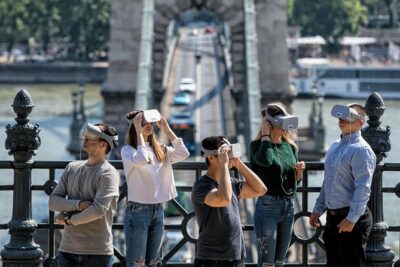
Nightmare in Budapest Interactive Horror Experience
Read our review →

PÁNiQ-SZOBA | VR Escape Rooms by PANiQ ROOM in Budapest
Read our review →Browse the lists this tour appears in