
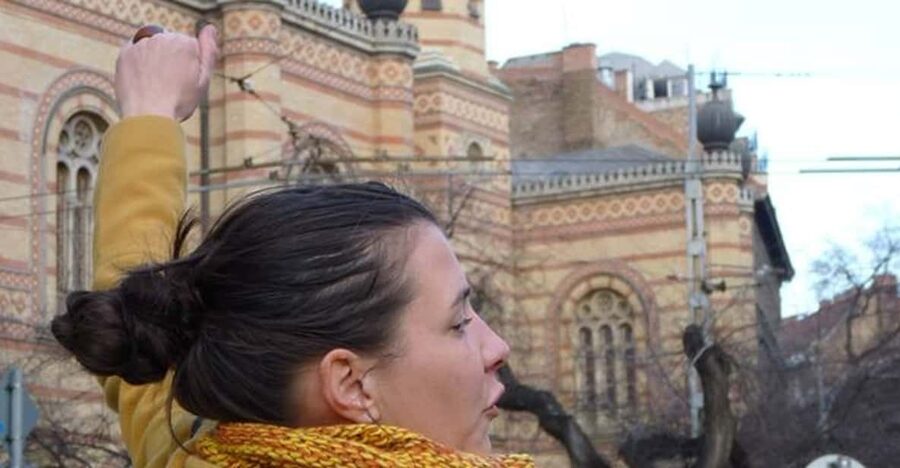
Reviewed · JEWISH HERITAGE TOURS
Jewish Quarter of Budapest Walking Tour
Budapest’s Jewish Quarter is not just a pretty district of cafés and ruin bars. It is a place where synagogue courtyards, wartime memories, tiny symbols, street art, and late-night drinking culture sit almost side by side. This 1.5-hour walk connects those pieces, with guides such as Judit, Ester, Gary, Dora, and Edith bringing their own stories and style.
I like the route for two clear reasons: it links three important synagogues into one easy walk, and it treats the difficult parts of Jewish and Hungarian history with care. I also like the finish at a ruin bar, which gives you a practical look at how the quarter functions today.
The main consideration is the payment model. The $2.27 booking price mainly reserves your place and covers administration. You are expected to tip the guide afterward, with €10 per person given as a usual reference point. The tour is also in English at an upper-intermediate level, so it may not suit every visitor.
In This Review
- Key points to know before you book
- Start at the Budapest Eye and set the tone
- Three synagogues, one Jewish Triangle
- Stories of Hungarian Jews and the Righteous Gentiles
- Look down, look up, and notice the small symbols
- The final stop at a Budapest ruin bar
- What the price really means
- English level, group size, and pacing
- Who will get the most from this walk
- Should you book the Jewish Quarter of Budapest Walking Tour?
- FAQ
- How long is the Jewish Quarter of Budapest Walking Tour?
- Where does the tour begin?
- Where does the tour finish?
- Does the tour enter the synagogues?
- What language is the tour in?
- How much should I pay the guide?
- Can groups of eight or more book this tour?
- Is the walking tour wheelchair accessible?
Key points to know before you book
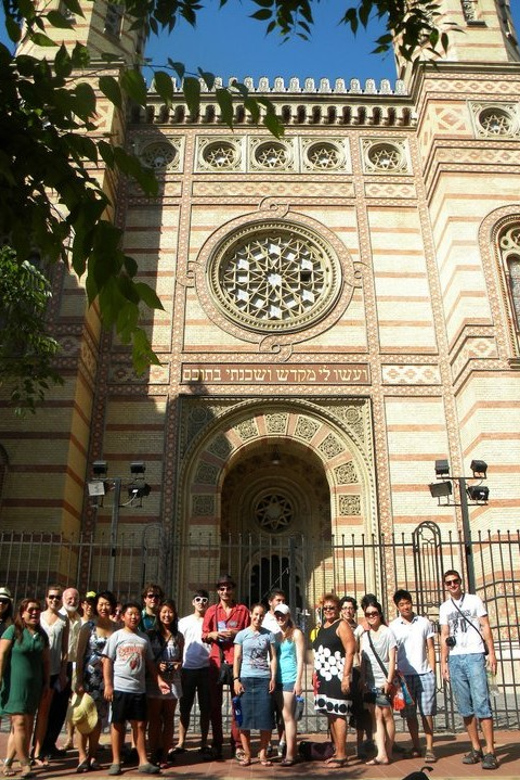
- Three synagogues form the route’s backbone: You see the Jewish Triangle from outside and learn how the buildings fit into the district’s story.
- The history is personal and serious: Expect discussion of Hungarian Jews, the Holocaust era, and the Righteous Gentiles.
- Street art and small symbols matter: The walk looks beyond major sights to details you might otherwise pass without noticing.
- The ending changes the mood: You finish at a local ruin bar, often including Szimpla Kert, with time for Budapest nightlife suggestions.
- Your guide shapes the experience: Judit, Ester, Gary, Dora, Andy, Ursula, Emmy, and Edith have all led tours, so the tone can vary.
- The low booking price is not the full cost: Plan for a donation, with €10 per person offered as a typical amount.
Start at the Budapest Eye and set the tone
The meeting point is beside the fountain near the Budapest Eye ferris wheel. Look for the royal blue flag. This is a sensible central location, but the open space around a popular city landmark can be busy, so arrive early enough to find the flag without rushing.
The tour returns to the same meeting point at the end. That makes it easy to continue into central Budapest, return to your hotel, or head back toward the quarter for dinner. It also means you do not need to arrange transport from a distant final stop.
This is a walking tour, not a synagogue admission tour. You will visit the three synagogues that make up the Jewish Triangle from the outside, while your guide explains their place in Budapest’s Jewish life and in the surrounding district. If you want to enter the synagogues, you will need to do that separately.
That distinction matters. A visitor expecting interior visits may feel the route is incomplete, while someone looking for a street-level introduction will find the format efficient. The guide can show you where the buildings are and provide context, but the tour does not replace a dedicated synagogue visit.
More of Jewish Budapest:
- Budapest Jewish Heritage Memorial Walking Tour & Synagogue Entry
★ 5.0 · 568 reviews - Budapest: Jewish Heritage Guided Tour with Synagogue Ticket
★ 4.8 · 533 reviews - Budapest walking tour: Parliament and Shoes Memorial
★ 5.0 · 387 reviews
Three synagogues, one Jewish Triangle
The Jewish Triangle gives the walk a useful shape. Instead of hearing a loose collection of facts, you move between three major religious landmarks and see how Jewish life was anchored in this part of Budapest.
The supplied details do not name the three synagogues, so you should not expect a detailed architectural comparison in advance. The value is the connection between the buildings, the neighborhood, and the people who used them. Your guide can point out how the district’s religious, residential, and commercial life came together.
This part of the route also helps correct a common misunderstanding. The Jewish Quarter is not only a memorial zone, and it is not only a nightlife zone. The synagogues make clear that this was a lived-in community with worship, family life, work, and local traditions.
The strongest guides use the buildings as a doorway into wider questions. How did Hungarian Jews fit into Budapest society? What changed during the Second World War? How did the quarter become the district you see today? The route is short, but those questions give it weight.
Because the tour does not enter the synagogues, wear comfortable shoes and pay attention to the guide rather than expecting long interior stops. You are likely to spend much of the time outdoors, so shade and water matter in warm weather.
Stories of Hungarian Jews and the Righteous Gentiles
The historical section is the emotional center of the walk. You learn about Hungarian Jews and the people known as the Righteous Gentiles, who helped Jews during the persecution and killings of the Holocaust period.
This subject needs a steady guide, and that is where the individual leaders matter. Judit has been praised for explaining painful material clearly and patiently. Ester is described as a strong storyteller who made the subject personal. Gary is energetic and willing to answer questions, while Edith is noted for a clear speaking voice and a caring manner.
Those differences can affect your experience. One guide may focus more on dates and political context. Another may spend more time on individual stories, symbols, or modern Budapest. The route remains broadly similar, but the delivery will not be identical from one departure to the next.
I appreciate that the tour does not treat tragedy as a dramatic prop. The most useful comments from the guides balance heartbreak with explanation. You get a sense of what happened, why the district mattered, and how the past still affects the way the neighborhood is understood.
Still, this is a brief walk. One visitor wanted more about Jewish daily life before the Second World War, and that is a fair limitation. The tour gives you an introduction to the community and its destruction, but not a full social history of prewar Budapest. If that period is your main interest, allow time for further reading or a museum visit.
Look down, look up, and notice the small symbols
A major strength of this walk is its attention to details that are easy to miss. The guide may point out symbols, small memorial references, miniature statues, and pieces of urban art that help explain Budapest’s character.
This is where the route moves beyond a standard list of monuments. You are not simply told that a building is old or important. You are encouraged to read the streets, spot visual clues, and connect present-day art with the district’s past.
The urban art section also gives the tour some breathing room after the heavier historical stories. Budapest’s Jewish Quarter has become one of the city’s best-known nightlife areas, and the walls, courtyards, and public spaces reflect that modern energy. The guide’s job is to show how the present grew around, and sometimes uneasily beside, the older neighborhood.
Do not expect every artwork or miniature statue to be a major attraction in itself. Their value comes from the explanation. Without the guide, you might walk past them. With the guide, they become small pieces of a larger picture.
This part suits curious visitors who like local observations as much as famous sights. It also gives you useful ideas for the rest of your stay. Several guides, including Gary, have offered suggestions for restaurants and bars after the walk.
More walking tours in Budapest:
- Budapest: Buda Castle Walk with Saint Stephen’s Hall
★ 4.5 · 3,012 reviews - Big Bus Budapest Hop-On Hop-Off Bus and Walking Tour
★ 3.5 · 2,206 reviews - Budapest: Buda Castle District Walking Tour
★ 4.6 · 2,108 reviews - Budapest City Landmarks Walking Tour in 2 Hours
★ 5.0 · 2,048 reviews
The final stop at a Budapest ruin bar
The tour ends at a local pub, with many departures finishing at a ruin bar such as Szimpla Kert. The timing is useful because you arrive before the main nighttime crowds, making it easier to look around and decide if you want to stay.
Ruin bars are a defining part of modern Budapest nightlife. Their appeal comes from unusual interiors, mismatched furniture, creative decoration, and a rough-edged reuse of old spaces. You do not need to make a full evening of it, but this ending lets you see the setting without having to find it alone.
I like this final stop because it connects the historical quarter to the city you experience after dark. The mood shifts from wartime stories and religious landmarks to drinks, art, music, and social life. That contrast is not a distraction. It shows why the district can feel complicated and sometimes jarring.
The pub stop is not a full tasting experience, and the supplied information does not promise a drink or reserved seating. Treat it as a recommendation and orientation point. You can stay, ask for more local suggestions, or continue elsewhere.
Parents with toddlers can manage the walk if children remain quiet in a stroller, but the serious subject matter and pub ending are better suited to adults and older children. The tour is wheelchair accessible, though an accessible route can still feel different in a historic district with varied street conditions. Contact the operator if you need specific assistance.
What the price really means
The advertised price of $2.27 is unusually low, but it does not represent the guide’s full payment. It covers the booking and administrative side of reserving a place. The guide relies on donations at the end.
You should budget for the tip before booking. The stated usual amount is €10 per person, with some people giving more. That makes the practical cost closer to a standard pay-what-you-feel walking tour, not a nearly free private sightseeing experience.
This model can be good value if you want a short introduction and prefer to decide afterward what it was worth. It also rewards a guide who handles sensitive history well and answers questions with care. At the same time, you should be comfortable with the social expectation of tipping.
The overall value is strongest for a first visit. In 90 minutes, you get historical background, the three-synagogue route, contemporary art and symbols, nightlife orientation, and a list of local suggestions. You will not receive synagogue entry, a long museum-style lecture, or an in-depth account of every period in Hungarian Jewish life.
English level, group size, and pacing
The tour is conducted in English, and an upper-intermediate level is essential. This is more than a formality. The guide covers political history, religious terms, wartime events, and layered personal stories. If you often struggle with spoken English, you may miss important context.
The tour does not accept groups of eight or more, even if members book separately. That rule helps keep the walk manageable and allows questions without turning the guide into a public speaker addressing a large crowd.
The route lasts 1.5 hours. Several guides have been praised for keeping it moving while pausing at shady spots and avoiding long periods of standing. That is helpful in summer, though the walk remains outdoors and weather can affect comfort.
The length is a good fit if you want a focused introduction before dinner. It may feel short if you want a full account of Budapest’s Jewish community, or if you enjoy extended time at each landmark. One guide may also leave you wishing for more, especially if the stories spark further questions.
Who will get the most from this walk
I would choose this tour if you want historical context before exploring the Jewish Quarter on your own. It suits first-time visitors, people interested in Jewish and Hungarian history, and anyone who wants to understand why the district is both a place of memory and a nightlife center.
It is also a good choice if you enjoy guides who explain small details rather than rushing from one postcard view to the next. The route’s street symbols, miniature statues, urban art, and local recommendations give you things to notice later.
You may want a different experience if you need synagogue interiors, a strictly academic lecture, or a tour devoted only to Holocaust memorials. This walk mixes serious history with present-day culture, so its scope is broad rather than narrowly specialized.
Bring water, wear comfortable shoes, and arrive at the Budapest Eye fountain with enough time to find the royal blue flag. Since the meeting point and finish are the same, you can plan your evening around the nearby quarter without arranging a pickup.
Should you book the Jewish Quarter of Budapest Walking Tour?
Book it if you want a thoughtful first look at the district and are happy with an outdoor route, English commentary, and a donation-based payment model. The strongest reasons are the careful treatment of difficult history, the three-synagogue framework, and the useful finish at a ruin bar.
Keep your expectations precise. You will not enter the synagogues, and 90 minutes cannot cover every part of Jewish life in Budapest. But for a low booking fee plus a fair donation, this is a practical way to connect the city’s past with its present, then continue exploring with better bearings.
FAQ
How long is the Jewish Quarter of Budapest Walking Tour?
The tour lasts 1.5 hours. Starting times vary, so you need to check availability for the date you want.
Where does the tour begin?
Meet beside the fountain at the Budapest Eye ferris wheel. The guide will hold a royal blue flag so you can identify the group.
Where does the tour finish?
The activity ends back at the Budapest Eye meeting point, although the route also includes a final stop at a local pub or ruin bar.
Does the tour enter the synagogues?
No. The tour visits the three synagogues that make up the Jewish Triangle from the outside. You can enter the synagogues separately on your own.
What language is the tour in?
The tour is conducted in English by a live guide. An upper-intermediate level of English is essential.
How much should I pay the guide?
The $2.27 booking fee is for administration and does not contribute to the guide’s earnings. Guides depend on donations, and €10 per person is given as the usual amount, though you can choose what to pay.
Can groups of eight or more book this tour?
No. Groups of eight or more are not allowed to book, even if they make separate reservations.
Is the walking tour wheelchair accessible?
Yes, the activity is listed as wheelchair accessible. You may still wish to contact the operator if you require specific assistance.
Recently added around Budapest
- Hiking + Chairlift ride + viewpoints in Budapest★ 5.0 · 3 reviews
- FoolsCode: EscapeRoom/Sightseeing tour with Actor Tourguide★ 5.0 · 3 reviews
- Grand Budapest tour with private transportation★ 5.0 · 3 reviews
- Budapest: Private Customizable Tour in French★ 5.0 · 3 reviews
- Budapest Drinks and Piano Show Cruise★ 4.5 · 3 reviews
- Discover Budapest Using Tram Two★ 5.0 · 3 reviews
- Budapest: Private, Personalized Pub Crawl, 3 drinks included★ 4.5 · 3 reviews
- Budapest: Private 3-Hour Gödöllő Palace Tour★ 4.9 · 3 reviews
Jewish Heritage Tours, compared.
Budapest Jewish Heritage Memorial Walking Tour & Synagogue Entry
Read our review →
Jewish Heritage Guided Tour with Synagogue Ticket
Read our review →

Budapest Dohany Synagogue & Hungarian Jewish Museum & free extras
Read our review →
Jewish History Guided Walking Tour with Historian
Read our review →
Budapest Dohany, Heroes’, Rumbach synagogues & Jewish Ghetto Tour
Read our review →
Browse the lists this tour appears in