
Reviewed · COMMUNIST-ERA HISTORY TOURS
Communism in Hungary with a Historian
Budapest’s Communist past is easiest to grasp when you see how it shaped ordinary streets, churches, monuments, and family life. This small walking tour links Elizabeth Square, Szabadság tér, and Parliament with stories of nationalization, fear, religious compromise, and the 1956 uprising.
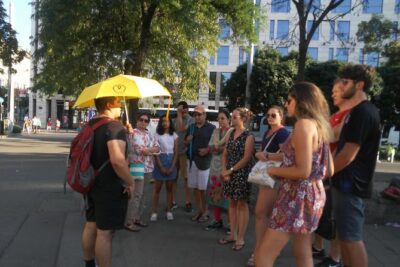
I like the maximum group size of 10, which gives you room to ask questions, and I like the way the tour crosses both Pest and Buda instead of treating Communism as a few statues in one park. The included metro ticket and coffee at the old-style Bambi Café add useful local texture. The main drawback is that most stops are outside, and the tour can feel chilly or wet in poor weather.
In This Review
- Key points to know before booking
- Why this tour adds something to ordinary Budapest sightseeing
- Starting at former Stalin Square
- St. Stephen’s Basilica and religious life under Communism
- Szabadság tér, where political memory crowds the pavement
- Parliament and the tragedy of Bloody Thursday
- Riding the metro across the city
- Bambi Café and the taste of the Communist era
- Guides who make the subject easier to follow
- Price, group size, and the value of three hours
- Who will get the most from this walk
- Should you book Communism in Hungary with a Historian?
- FAQ
- Where does the tour start?
- What time does the tour begin?
- How long does the tour last?
- How large is the group?
- What language is the tour offered in?
- Is public transportation used?
- Does the tour enter St. Stephen’s Basilica?
- Does the tour enter the Hungarian Parliament Building?
- Where does the tour end?
- Can I cancel for a refund?
Key points to know before booking
- Personal stories make the politics human: Guides may explain how nationalization affected their own families, including forced changes to work and housing.
- The 1956 revolution gets a clear focus: Parliament’s Kossuth Square is used to explain Bloody Thursday, one of the uprising’s most painful events.
- You visit more than one side of Budapest: The route begins in central Pest and usually finishes in Buda near Margaret Bridge.
- A Communist-era café closes the afternoon: Bambi Café, opened in 1961, provides a place to talk over coffee and connect the past with present-day Hungary.
- The group is genuinely small: No more than 10 people join, a useful advantage on a discussion-heavy history walk.
- Plan for a walking tour, not museum visits: Churches and major buildings are viewed from outside, and the bunker is discussed from the exterior.
Why this tour adds something to ordinary Budapest sightseeing
Budapest’s grand architecture can make the city’s recent past easy to miss. You see imperial façades, the Danube, and the Parliament, but the Communist decades are often reduced to a quick mention of Soviet control. This tour gives that period a human scale.
The emphasis is not only on leaders, dates, and ideology. You hear about work, housing, education, churches, political fear, and the pressure to show loyalty to the party. One especially memorable family story concerns a factory that was nationalized. The owner’s grandfather was made to work in his own former business for low pay, under a party loyalist who had little practical experience.
Another story explains how a family was forced to surrender apartments and move into poorer quarters with another family. Details like these help you understand that Communism was not an abstract system discussed in a textbook. It reached into kitchens, workplaces, churches, and private conversations.
The tour also places Hungarian Communism beside the years before it. Depending on your guide, you may hear about the interwar period, the Second World War, the Kingdom of Hungary, and the political choices that shaped the postwar state. That wider frame matters. Hungary’s Communist era did not appear from nowhere, and the 1956 uprising makes more sense when you know what came before it.
More on Budapest under communism:
- Budapest: Communist History Tour with House of Terror Option
★ 4.8 · 182 reviews - Budapest: 3-Hour Walking Tour About Communism (Small Group)
★ 4.7 · 70 reviews - Budapest Hammer & Sickle Communist Times Tour
★ 4.5 · 68 reviews
Starting at former Stalin Square
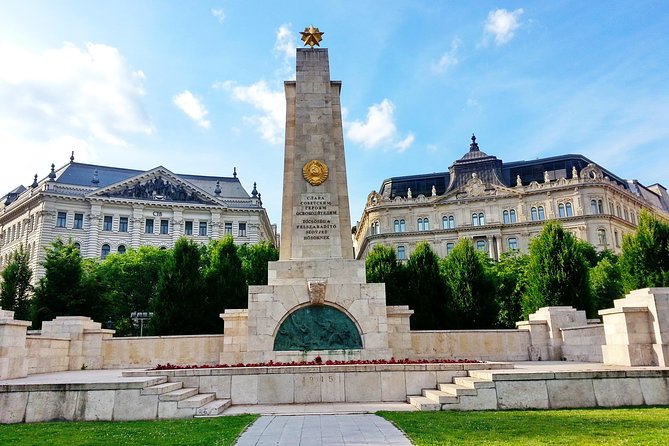
The meeting point is beside the Kempinski Hotel Corvinus at Elizabeth Square, Erzsébet tér 7 to 8. The tour begins at 2 p.m., and the square serves as more than a convenient central meeting place.
You start with the area’s connection to the Communist period, including its former identity as Stalin Square. The guide points out monuments and uses them to explain how public spaces were renamed, redesigned, and given political meaning. You spend about 15 minutes here, enough to set the stage without getting bogged down in opening formalities.
This is a smart beginning because Elizabeth Square is central, easy to reach, and close to the metro. If you are staying in central Budapest, the start is simple. Arrive a little early so you can locate the Kempinski entrance and avoid beginning the afternoon in a scramble.
St. Stephen’s Basilica and religious life under Communism
The walk continues to St. Stephen’s Basilica, known in Hungarian as Szent István Bazilika. You view the church from outside and spend about 15 minutes discussing religion under Communist rule.
Do not book this tour expecting a basilica interior visit. Admission is not included, and the stated plan is to see the building from the street. The value here is the conversation about how churches survived in a state that promoted atheism and demanded political conformity.
The guides use family accounts to explain the uneasy relationship between religious institutions and the party. One point raised on the tour is that churches sometimes had to make financial concessions, including donations to the party, in order to continue operating. This gives you a more complicated picture than a simple story of religion being banned outright.
If you have already toured the basilica inside, this stop works well as a historical counterpoint. If interior architecture is your main goal, it may feel brief. The focus is on religious life and political pressure, not art or church decoration.
Szabadság tér, where political memory crowds the pavement
Allow the most time for Szabadság tér, or Liberty Square. The group spends about 45 minutes here, and that longer pause makes sense. The square contains several reminders of Hungary’s twentieth-century conflicts, including memorials, statues, embassies, and remnants connected with wartime and Communist-era power.
Your guide reads the space as a collection of competing memories. A monument may express one official version of events, while a nearby statue or public response reflects another. This makes Szabadság tér one of the strongest parts of the route for understanding how history remains politically sensitive in Budapest.
You also hear about part of a bunker visible from outside. The tour does not promise entry, so think of this as a location-based explanation rather than an underground visit. Some accounts also refer to an old terminal or station connected with the route, but the exact stops can vary with conditions and the guide’s presentation.
This section rewards questions. Ask how public memory changed after 1989, how people managed daily life, or how the state controlled information. The small group limit matters here. On a large tour, a place like Szabadság tér can turn into a quick photo stop. With up to 10 people, you have a better chance to pause and follow the discussion.
A different kind of day in Budapest:
- Budapest: City Highlights Cruise with Welcome Drink
★ 4.6 · 35,610 reviews - Budapest: Unlimited Prosecco, Beer and Aperol Spritz Cruise
★ 4.8 · 25,310 reviews - Budapest: Széchenyi Spa Day Ticket with Optional Upgrades
★ 4.3 · 23,911 reviews - Budapest: Nighttime or Daytime Sightseeing Cruise
★ 4.2 · 21,062 reviews
Parliament and the tragedy of Bloody Thursday
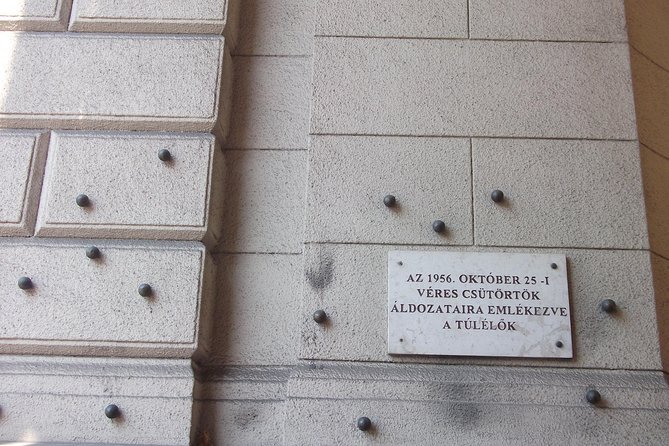
The route then reaches the Hungarian Parliament Building, one of Budapest’s most recognizable sights. You do not enter the building as part of this tour, and admission is not included. Instead, the guide focuses on Kossuth Square and one of the key events of the 1956 revolution, known as Bloody Thursday.
Standing in the square gives the story a physical setting. Rather than treating the uprising as a distant political episode, the guide explains what happened in front of Parliament and why the event became such a powerful part of Hungarian memory.
This is also a good point to connect the public story with the private stories heard earlier. The revolution was not only about governments and troops. It affected families, jobs, safety, and the choices people had to make when the political order began to crack.
You will likely appreciate the contrast between the polished Parliament exterior and the difficult history attached to the square. Budapest often presents beauty and pain side by side. This stop makes that contrast clear without requiring a museum ticket or a long detour.
Riding the metro across the city
A metro ride is part of the route, and the ticket is included. That small detail improves the tour in two ways. First, you cover more ground than a walking route limited to central Pest. Second, you use a normal part of city life while discussing a period in which public transport, work, and urban movement were part of everyday experience.
The tour explores Buda and Pest, so the metro transfer helps connect the two sides without wasting a large part of the three-hour schedule. You should still expect a fair amount of walking, standing, and outdoor discussion. Comfortable shoes are more useful than anything formal.
The exact ending can depend on weather. On colder or wet days, the group often remains on the Pest side near the starting area. In better conditions, the tour usually ends at Bambi Café on the Buda side, close to the center and Margaret Bridge.
Bambi Café and the taste of the Communist era
The usual ending is Bambi Café at Frankel Leó út 2 to 4. This café opened in 1961 and has retained much of its old character, making it a fitting place to finish a tour about Communist-era daily life.
Coffee is included, and the café gives you time to sit down after the walk. The important point is not the drink itself. It is the chance to talk through what you have seen in a setting linked to the period. Some tour participants have also used the final stop to discuss current events and how Hungary’s past still shapes its politics.
Because the café ending can change in bad weather, do not treat Bambi as an absolute guarantee. If you are particularly interested in seeing it, ask the operator about the planned ending before you book or shortly before the tour begins.
Guides who make the subject easier to follow
The tour is led by members of Budapest Explorers, and the guide you receive may vary. Named guides connected with this experience include Judit, Raymond, Gabriel, Gábor, Greg, Virág, András, Peter, Daniel, and Ádám.
The strongest feature across the guide team is the use of clear storytelling. Gábor has been with Budapest Explorers from its early years, and his approach is described as balanced, honest, and easy to follow. Virág has studied the Communist era closely and wrote a thesis on the subject, making her a strong fit if you want more political and historical detail.
Raymond’s family account of nationalization, housing, and party control shows the kind of personal material that can make this tour stick with you. Greg is described as friendly and open to questions, while András and Gabriel are noted for combining history with patient, engaging explanations. Guides may also share their own experiences of living under Communism for part of their lives.
That personal angle is valuable, but it also means each departure may feel slightly different. You will not get a fixed audio script. One guide may spend more time on the secret police, another on religion, family life, the Second World War, or the 1956 revolution.
Price, group size, and the value of three hours
At $59.13 per person, this is not the cheapest walking tour in Budapest. Still, the price includes about three hours with a historian-style guide, a metro ticket, and coffee. The group is capped at 10, which is a major part of the value.
You are paying for interpretation rather than entry tickets. The tour does not include indoor access to St. Stephen’s Basilica, Parliament, or the bunker. If you prefer museums and interiors, you may find the cost harder to justify. If you want context that connects several public sites, the smaller group and guide-led discussion make the price more reasonable.
The tour is commonly booked around 23 days ahead, so it is sensible to reserve before your visit if your schedule is tight. It is offered in English and confirmation arrives at booking. Most people can participate, service animals are allowed, and the route is near public transport.
Free cancellation is available until 24 hours before the 2 p.m. start time. After that point, the payment is not refunded, and changes made inside the 24-hour window are not accepted.
Who will get the most from this walk
I would choose this tour if you want Budapest’s Communist period explained through buildings, squares, and real family consequences. It suits anyone interested in the Cold War, the 1956 revolution, the Second World War, political memory, or the way ordinary people coped with state control.
It is also a good choice if you have already seen the city’s main sights and want a different layer of Budapest. The route shows familiar places in a new light. A church becomes a place to discuss state pressure. Parliament becomes the setting for Bloody Thursday. A café becomes a reminder of how daily life continued under a political system that many people did not choose.
You may want another tour if you dislike outdoor walking, need extensive indoor sightseeing, or want a specialist visit focused only on the secret police. One person specifically hoped for a tour devoted to that subject, and this experience does not promise that level of focus.
Should you book Communism in Hungary with a Historian?
Book it if you want a small, thoughtful history walk rather than a checklist of famous buildings. The best parts are the personal stories, the 1956 discussion at Parliament, the competing memories at Szabadság tér, and the final conversation at Bambi Café.
Skip it if you mainly want interiors, formal museum exhibits, or a short route with little discussion. For everyone else, the combination of a three-hour schedule, small group, included metro ticket, and guides such as Virág, Raymond, Gábor, Greg, and András makes this a useful way to understand a part of Budapest that standard sightseeing often leaves out.
FAQ
Where does the tour start?
It starts at Kempinski Hotel Corvinus Budapest, Erzsébet tér 7 to 8, 1051 Hungary.
What time does the tour begin?
The scheduled start time is 2 p.m.
How long does the tour last?
The tour lasts approximately three hours.
How large is the group?
The maximum group size is 10 people.
What language is the tour offered in?
The tour is offered in English.
Is public transportation used?
Yes. The route includes travel by metro, and the metro ticket is included.
Does the tour enter St. Stephen’s Basilica?
No. The basilica is viewed from outside, and admission is not included.
Does the tour enter the Hungarian Parliament Building?
No. The Parliament Building is discussed from the outside, with attention given to Bloody Thursday in Kossuth Square.
Where does the tour end?
It usually ends at Bambi Café on the Buda side near central Budapest and Margaret Bridge. In colder or wet weather, it often ends on the Pest side near the starting area.
Can I cancel for a refund?
Yes. You can cancel up to 24 hours before the start time for a full refund. Cancellations or changes made less than 24 hours before the tour are not accepted for a refund.
Recently added around Budapest
- Hiking + Chairlift ride + viewpoints in Budapest★ 5.0 · 3 reviews
- FoolsCode: EscapeRoom/Sightseeing tour with Actor Tourguide★ 5.0 · 3 reviews
- Grand Budapest tour with private transportation★ 5.0 · 3 reviews
- Budapest: Private Customizable Tour in French★ 5.0 · 3 reviews
- Budapest: Private, Personalized Pub Crawl, 3 drinks included★ 4.5 · 3 reviews
- Budapest Drinks and Piano Show Cruise★ 4.5 · 3 reviews
- Discover Budapest Using Tram Two★ 5.0 · 3 reviews
- Budapest: Private 3-Hour Gödöllő Palace Tour★ 4.9 · 3 reviews
Communist-Era History Tours, compared.
Communist History Tour with House of Terror Option
Read our review →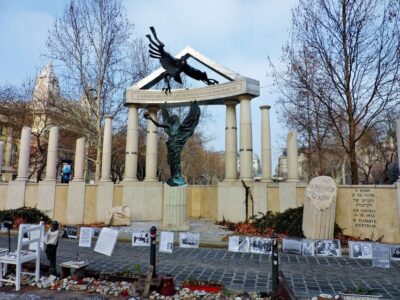
3-Hour Walking Tour About Communism (Small Group)
Read our review →
Lives of Hungarians Under Communist and Capitalist system
Read our review →
Private Budapest Hammer & Sickle Communist Times Tour
Read our review →
Communist History Evening Walking Tour of Budapest
Read our review →Browse the lists this tour appears in