
Reviewed · COMMUNIST-ERA HISTORY TOURS
Communist Budapest Walking Tour
Budapest’s communist past is easiest to understand through its streets, not just its museums. This three-hour tour links the sites of the 1956 uprising, Cold War symbols, 1970s housing estates, and Socialist Realist statues into one moving story about life under Goulash Communism. I especially like the preserved 1960s coffeehouse and the guide’s old photographs, which show how much these streets have changed.
I also like the use of ordinary public transport. The metro and a Stalin-era trolley bus are not just ways to get around; they help you see how the city worked. The main drawback is that the tour covers a lot of ground and ideas in three hours, so some stops may feel brief. One participant found the commentary too basic, especially after visiting similar tours in Prague and Berlin.
In This Review
- Key points at a glance
- Why this tour is different from a standard Budapest walk
- Bem József Square and the first 1956 demonstration
- Kossuth Square and the violence of 1956
- Freedom Square’s four Cold War symbols
- 1970s housing estates and the promise of modern life
- Puskás Stadium and Socialist Realist figures
- A Stalin-era trolley bus and the May Day parade route
- The House of Terror and the memory of repression
- How much value do you get for $123?
- Who will enjoy this three-hour route?
- Should you book Communist Budapest Walking Tour?
- FAQ
- How long is the Communist Budapest Walking Tour?
- Where does the tour start?
- What language is the tour offered in?
- Who leads the tour?
- Is the tour private or shared?
- Are metro and tram tickets included?
- Which 1956 site does the tour visit first?
- Does the tour visit the House of Terror Museum?
- What can you see at Freedom Square?
- Can I cancel for a full refund?
Key points at a glance
- Start at Bem József Square: See where the first large demonstration of the 1956 uprising began and visit a coffeehouse with its original 1960s interior.
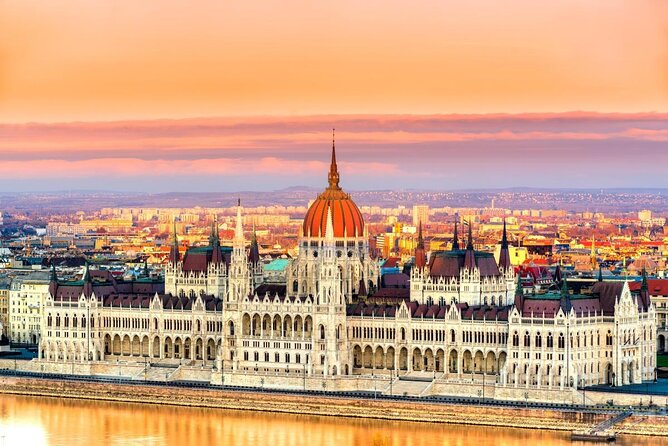
- Stand before Parliament at Kossuth Square: Learn how this important public space became tied to political and armed conflict during the revolution.
- Read the Cold War in four structures: Freedom Square brings together the U.S. embassy, Soviet war memorial, Ronald Reagan statue, and atomic shelter entrance.
- See the human side of housing policy: 1970s apartment blocks reveal why grey concrete could represent progress and good fortune to young families.
- Spot Socialist Realism at Puskás Stadium: Heroic workers, soldiers, and intellectuals still point toward the bright future promised by the old regime.
- Use old photos to read modern Budapest: An iPad presentation helps you compare Stalin-era parade routes with the city you see today.
Why this tour is different from a standard Budapest walk
Many Budapest walks focus on royal buildings, cafés, bridges, and the grand architecture of the Austro-Hungarian era. This one asks you to look at the decades after World War II, when Hungary lived under one-party rule, Soviet influence, shortages, surveillance, and tightly controlled public life.
The tour centers on what was sometimes called Goulash Communism. The phrase describes a system that offered Hungarians modest personal freedoms and better consumer choices than people in some other Eastern Bloc countries, provided they did not challenge the state on major political issues. That compromise is the key to understanding why the period cannot be reduced to either total misery or easy comfort.
You will see places tied to open rebellion, but also places tied to routine life: apartment blocks, public transport, sports facilities, cafés, and parade routes. That mix is useful. It shows how political control reached into daily habits, while also explaining why some people remember the era with a complicated blend of fear, frustration, stability, and social progress.
The guide is an important part of the experience. The tour is led in English by a historian, professor, doctoral student, journalist, art critic, or published author. Andras is one named guide associated with the tour, and one account describes his relaxed, conversational style and his ability to adjust the route when the group had already seen certain sights.
That flexibility matters on a subject like this. If you already know the basic dates, you will want the guide to spend less time reciting facts and more time explaining how the political system affected ordinary Hungarians. If you know little about the period, the route gives you a useful framework before you visit a museum.
More on Budapest under communism:
- Budapest: Communist History Tour with House of Terror Option
★ 4.8 · 182 reviews - Communism in Hungary with a Historian
★ 5.0 · 70 reviews - Budapest: 3-Hour Walking Tour About Communism (Small Group)
★ 4.7 · 70 reviews
Bem József Square and the first 1956 demonstration
The meeting point is Bambi Espresso at Frankel Leó út 2/4, in Budapest’s second district. Starting here gives the tour a more local feel than beginning at one of the city’s grandest monuments.
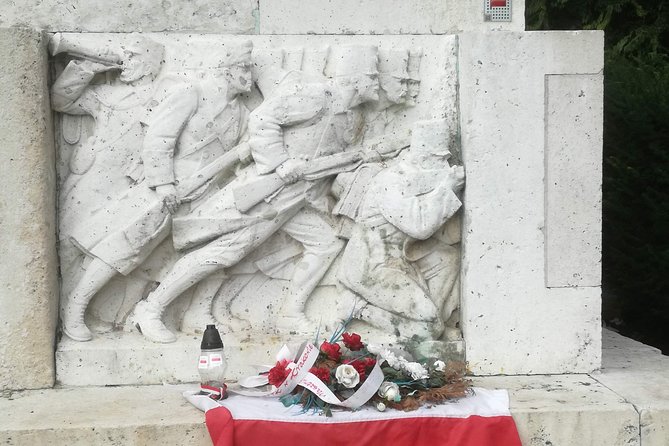
Bem József Square is tied to the opening of the 1956 uprising. The first large demonstration took place here, making the square a natural starting point for a tour about the collapse of public obedience. Your guide can explain why a protest that began with demands for reform soon grew into a national revolt against Soviet control and the Hungarian communist government.
The square also helps you see how quickly a public gathering can become political. In an authoritarian system, a crowd in a central space is never just a crowd. The meaning of slogans, statues, flags, and speeches changes once people realize that others share their anger.
A coffeehouse with its original 1960s interior adds a more intimate note. Instead of discussing the period only through battles and government decrees, you get a glimpse of the rooms where people met, talked, and spent time under the social rules of the era.
This is one of the tour’s strongest details because the setting is ordinary. You are not looking only at a commemorative plaque. You are considering how a person might have experienced Budapest through a coffee, a conversation, and the careful limits of what could be said in public.
Kossuth Square and the violence of 1956
From Bem József Square, the tour uses the metro to reach Kossuth Square. Metro tickets are not included, so you need to budget separately for the public transport used during the walk.
Kossuth Square, in front of Parliament, is one of the most important political spaces in Budapest. During the 1956 revolution, it became the scene of major events, including political conflict and armed violence. The monuments here bear witness to those clashes and help connect the uprising to the national government at the heart of the city.
This stop works best if you pause to consider the setting. Parliament represents state authority, while the square became a place where citizens demanded a different kind of government. The contrast between the grand building and the memory of violence gives the story weight without requiring a long museum visit.
The guide’s job here is to explain cause and effect. You are not simply told that 1956 happened. You should come away understanding how demonstrations, demands for reform, Soviet intervention, and the eventual defeat of the uprising fit together.
One practical point: this is a walking tour, not a stop-by-stop museum circuit. You will hear a great deal while standing outdoors and moving between sites. Wear comfortable shoes, and expect to concentrate as you walk.
Freedom Square’s four Cold War symbols
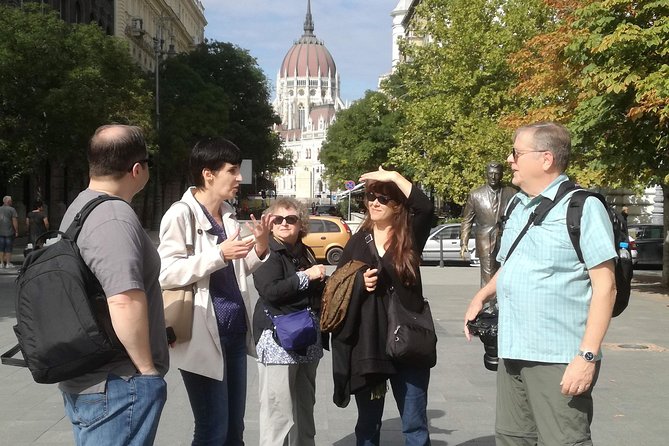
A short walk brings you to Freedom Square, where the Cold War appears in a compact group of four structures.
The first is the U.S. embassy. The second is a monument to the Soviet army. The third is a statue of President Ronald Reagan. The fourth is the entrance to a secret atomic shelter. Together, these sites show how Budapest sat between rival political systems and military powers.
The value of this stop is the physical closeness of the symbols. The American embassy and Soviet monument speak to opposing blocs. Reagan’s statue recalls the later stage of the Cold War and the political pressure that helped shape its end. The atomic shelter points to the fear of nuclear conflict, a fear that was not limited to military planners or government leaders.
You can read Freedom Square as a lesson in changing memory. The political meaning of a monument does not remain fixed. A Soviet memorial, an American diplomatic building, and a statue of an anti-communist president occupy the same public space, each carrying a different message about power and freedom.
This part of the route is especially useful for anyone who knows the Cold War mainly through Berlin or Washington. Budapest offers a different view, one shaped by life inside the Soviet sphere and by Hungary’s gradual movement toward political change.
More walking tours in Budapest:
- Budapest: Buda Castle Walk with Saint Stephen’s Hall
★ 4.5 · 3,012 reviews - Big Bus Budapest Hop-On Hop-Off Bus and Walking Tour
★ 3.5 · 2,206 reviews - Budapest: Buda Castle District Walking Tour
★ 4.6 · 2,108 reviews - Budapest City Landmarks Walking Tour in 2 Hours
★ 5.0 · 2,048 reviews
1970s housing estates and the promise of modern life
The metro takes you to one of the 1970s housing estates at the edge of the city center. At first glance, the apartment blocks may seem drab and grey. That first impression can be misleading.
When these buildings were new, young Hungarian families were delighted to receive an apartment there. The reason was practical: the blocks offered elevators and modern conveniences that were missing from many of Budapest’s older buildings. A private flat with reliable facilities could feel like a major improvement, even when the architecture looked plain.
This is one of the most useful parts of the route because it complicates the usual picture of communism. The state could be repressive and still deliver housing, infrastructure, education, or other improvements that mattered to families. Understanding that tension helps explain why the period is remembered differently by different generations.
The housing estate also gives you a chance to think about the gap between appearance and lived experience. Today, concrete blocks may suggest neglect or uniformity. In the 1970s, they could signal a fresh start, a larger home, and a better daily routine.
Do not expect a polished heritage site here. The appeal comes from seeing an ordinary residential setting and listening to the guide explain what it meant at the time. If you prefer famous monuments and grand interiors, this stop may feel less exciting. If you want a look at how policy shaped home life, it is essential.
Puskás Stadium and Socialist Realist figures
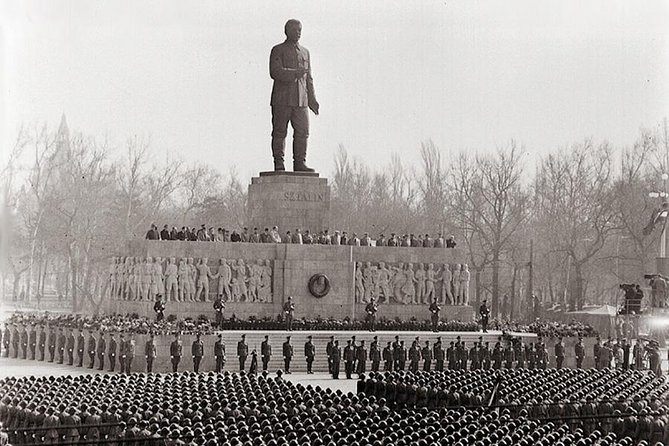
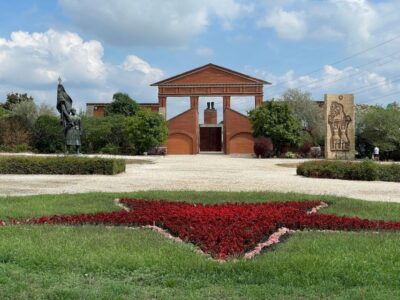
The former People’s Stadium, now Puskás Soccer Stadium, provides one of the clearest encounters with official communist art. It is one of the few places in Budapest where you can see typical Socialist Realist statues of workers, soldiers, and intellectuals.
These figures were designed to communicate strength, discipline, labor, and confidence in the future. Their bodies and poses are part of the message. They do not present uncertain citizens or private individuals. They present idealized people moving together toward a promised bright future.
The statues are worth seeing even if you are not an art specialist. Your guide can point out how the human form became a political tool and how public art taught people what a good citizen was meant to look like.
The stadium itself also links politics with mass events. Sports grounds were places for football, but they could also host rallies, ceremonies, and displays of national unity. The People’s Stadium belonged to the public image of the regime, not just to athletics.
This stop may be one of the most memorable for photographers and anyone interested in architecture or public art. It also provides a welcome visual break after the heavier political sites. You can see the symbols of the system rather than only hear about its laws and conflicts.
A Stalin-era trolley bus and the May Day parade route
The tour includes a short ride on one of Stalin’s trolley buses to Dózsa György Street. Public transport is again part of the story, not merely a transfer between attractions.
Dózsa György Street is a broad boulevard that was used for May Day parades. Your guide uses an iPad and old photographs to show how the street appeared during Stalin’s time and how it looks now.
This comparison is a smart teaching tool. A current street can seem neutral until you see crowds, banners, portraits, uniforms, and reviewing stands layered over the same view. The old images help you picture the scale and choreography of official celebration.
May Day parades were not casual festivals. They displayed loyalty, labor, military power, and the order of the state. The wide boulevard made the city suitable for mass spectacle, while participation could carry social and professional pressure.
The trolley bus ride adds a small taste of the period’s public infrastructure. It is brief, so do not expect a long historic transport outing. Its value lies in connecting the movement of people with the wider system that organized urban life.
The House of Terror and the memory of repression
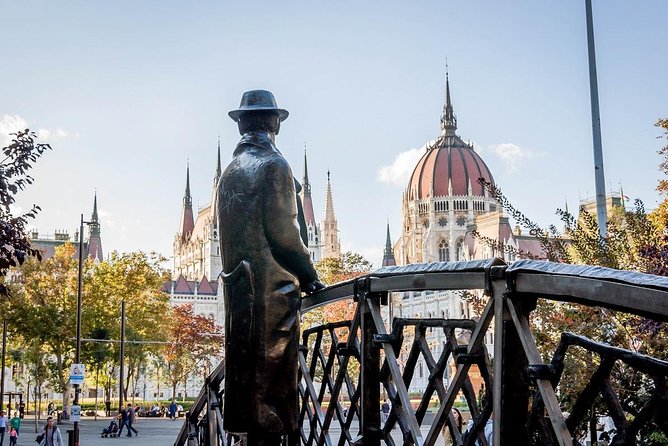
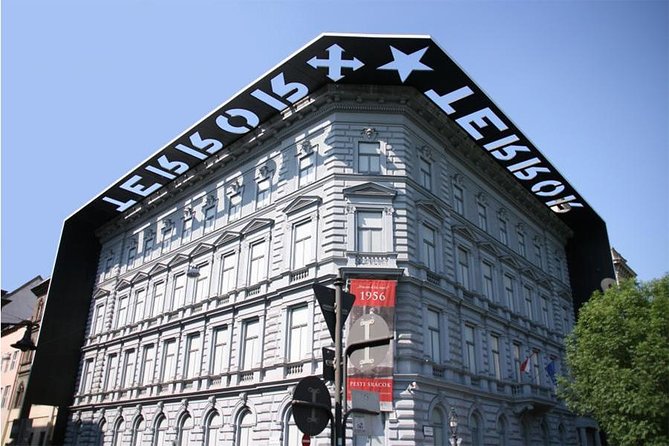
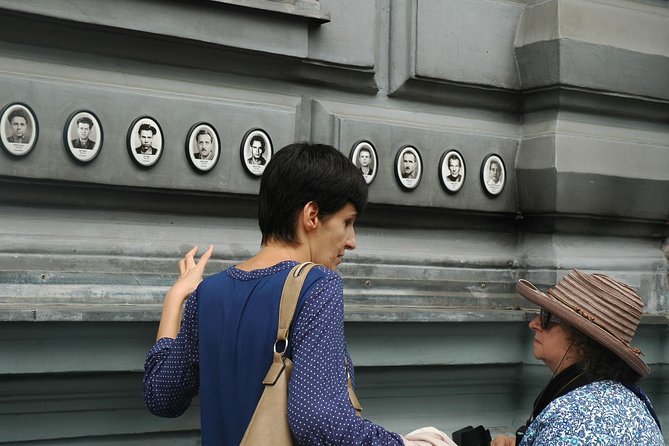
The route finishes near the House of Terror, a museum housed in the former headquarters of the secret services. The building commemorates the crimes of communism, with particular attention to the Stalinist years.
The museum itself is not listed as part of the three-hour tour, so you should clarify whether you want to visit it separately after the walk. The tour brings you to the building and explains its place in the story, but the time available is devoted to the wider route.
In front of the House of Terror is a slab of the Berlin Wall. It connects Hungary’s experience to the larger Cold War story and reminds you that the division of Europe was physical as well as political.
Ending here gives the tour a serious final note. Earlier stops show reform, housing, transport, art, and public spectacle. The House of Terror brings the focus back to surveillance, imprisonment, and state violence. That balance is important. The tour does not treat communist Budapest as a collection of unusual statues and nostalgic cafés.
If you plan to enter the museum afterward, allow extra time and prepare for difficult material. The building’s history is emotionally heavy, and seeing it after the walking tour may help you understand why the museum occupies such a powerful place in Budapest’s public memory.
How much value do you get for $123?
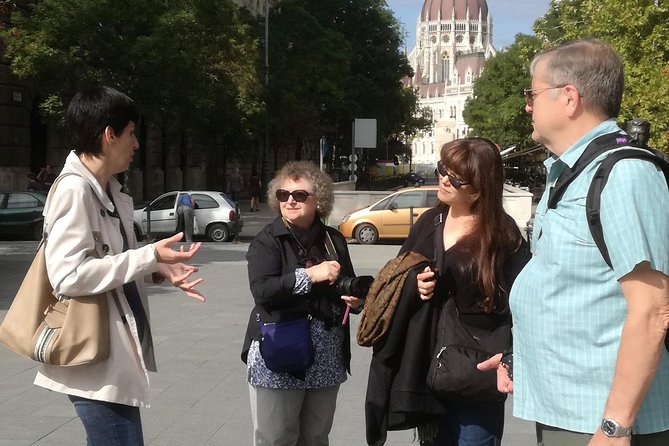
At $123 per person, this is not a bargain-priced city walk. The value depends on what you want from the guide.
You are paying for three hours with a specialist rather than for admission to a long list of attractions. The guide’s academic and professional background is a real part of the product, especially when the subject calls for political context and careful explanation. You also cover several areas of Budapest and use public transport between them, which would take more planning to organize alone.
The price makes more sense for a private booking or a small group, where you can ask questions and shape the conversation. One participant described the route as adaptable, with related places added when familiar sights had already been seen. That kind of adjustment is harder to get on a large, fixed group tour.
Still, you should set your expectations correctly. This is not a replacement for a full museum day, and it cannot explain every part of Hungarian life between 1945 and 1989 in three hours. One experienced participant felt the tour stayed close to the basics and did not add enough about daily life or the transition to democracy.
I would book it if you are new to Hungarian communist history, want a strong orientation, or value a guide who can connect monuments to ordinary life. If you already know the subject well, ask in advance how much time the guide can devote to the post-1968 period, Goulash Communism, and the fall of one-party rule.
The tour has a 4.9 rating from six reviews, which points to very strong satisfaction overall, but the small sample means you should also weigh the one detailed criticism. The experience seems to depend heavily on your existing knowledge and on how actively you ask questions.
Who will enjoy this three-hour route?
I would recommend it most strongly to:
- First-time visitors who want context for Budapest’s twentieth-century history
- People interested in the 1956 uprising and Cold War Europe
- Architecture and public-art fans who want to see housing estates and Socialist Realist statues
- Visitors who prefer ordinary neighborhoods and public spaces to a standard monument circuit
- Anyone planning to visit the House of Terror and wanting background first
It may be less suitable if you want to spend the whole time inside museums, avoid public transport, or already have a detailed grasp of Hungarian politics from 1945 to 1989.
The pace is described as relaxed, but the route still includes considerable walking, metro travel, and a trolley bus ride. A participant who enjoyed the content also found the amount of walking and information tiring by the end. Plan for mental fatigue as well as physical effort.
The tour is in English, and private or small-group formats are available. You can cancel up to 24 hours ahead for a full refund, and reserve now while paying later, which is useful when your Budapest schedule is still changing. Tram and metro tickets are extra.
Should you book Communist Budapest Walking Tour?
Book this tour if you want to understand how politics shaped ordinary streets and homes, not just see the grand symbols of the old regime. Bem József Square, Kossuth Square, Freedom Square, the housing estate, Puskás Stadium, and the House of Terror create a useful chain from revolt to repression, public spectacle, everyday improvement, and eventual political change.
I would choose a private or small-group version if the $123 price fits your budget. Ask questions, request more detail about daily life, and tell the guide what you already know. If your background is limited, the tour should give you a clear foundation. If you are already an expert, it may feel too introductory unless the guide adjusts the discussion.
FAQ
How long is the Communist Budapest Walking Tour?
The tour lasts three hours.
Where does the tour start?
It starts at Bambi Espresso, Budapest, Frankel Leó út 2/4, 1027 Hungary.
What language is the tour offered in?
The tour is offered in English.
Who leads the tour?
The guides are professors, doctoral students, historians, journalists, art critics, and published authors. Andras is one named guide associated with the experience.
Is the tour private or shared?
Private and small-group options are available.
Are metro and tram tickets included?
No. Tram and metro tickets are not included in the tour price.
Which 1956 site does the tour visit first?
The tour begins at Bem József Square, where the first large demonstration of the 1956 uprising was held.
Does the tour visit the House of Terror Museum?
The route takes you to the House of Terror, which occupies the former secret-service headquarters. Entry to the museum is not listed as included.
What can you see at Freedom Square?
You can see the U.S. embassy, a monument to the Soviet army, a statue of President Ronald Reagan, and the entrance to a secret atomic shelter.
Can I cancel for a full refund?
Yes. You can cancel up to 24 hours in advance for a full refund.
Recently added around Budapest
- Hiking + Chairlift ride + viewpoints in Budapest★ 5.0 · 3 reviews
- FoolsCode: EscapeRoom/Sightseeing tour with Actor Tourguide★ 5.0 · 3 reviews
- Grand Budapest tour with private transportation★ 5.0 · 3 reviews
- Budapest: Private Customizable Tour in French★ 5.0 · 3 reviews
- Budapest: Private, Personalized Pub Crawl, 3 drinks included★ 4.5 · 3 reviews
- Budapest Drinks and Piano Show Cruise★ 4.5 · 3 reviews
- Discover Budapest Using Tram Two★ 5.0 · 3 reviews
- Budapest: Private 3-Hour Gödöllő Palace Tour★ 4.9 · 3 reviews
Communist-Era History Tours, compared.
Communist History Tour with House of Terror Option
Read our review →
3-Hour Walking Tour About Communism (Small Group)
Read our review →

Lives of Hungarians Under Communist and Capitalist system
Read our review →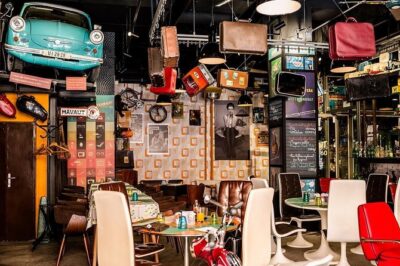
Private Budapest Hammer & Sickle Communist Times Tour
Read our review →
Browse the lists this tour appears in